
Textbook Question
Finding Extrema from Graphs
In Exercises 7–10, find the absolute extreme values and where they occur.

 Verified step by step guidance
 04:50
04:50
 07:09
07:09 05:34
05:34Finding Extrema from Graphs
In Exercises 7–10, find the absolute extreme values and where they occur.
Identifying Extrema
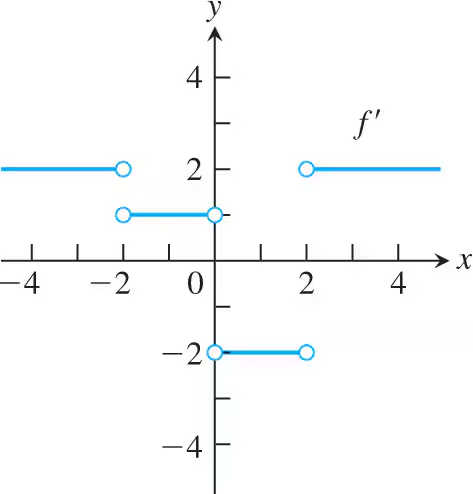
In Exercises 61 and 62, the graph of f' is given. Assume that f is continuous, and determine the x-values corresponding to local minima and local maxima.
Identify the inflection points and local maxima and minima of the functions graphed in Exercises 1–8. Identify the open intervals on which the functions are differentiable and the graphs are concave up and concave down.
2. y=x^4/4-2x^2+4
Absolute Extrema on Finite Closed Intervals
In Exercises 21–36, find the absolute maximum and minimum values of each function on the given interval. Then graph the function. Identify the points on the graph where the absolute extrema occur, and include their coordinates.
f(t) = 2 − |t|, −1 ≤ t ≤ 3
Each of Exercises 67–88 gives the first derivative of a continuous function y=f(x). Find y'' and then use Steps 2–4 of the graphing procedure described in this section to sketch the general shape of the graph of f.
77. y' = cot(θ/2), for 0 < θ < 2π
Finding Indefinite Integrals
In Exercises 17–56, find the most general antiderivative or indefinite integral. You may need to try a solution and then adjust your guess. Check your answers by differentiation.
∫(1 + cos 4t)/2 dt