Ch. 4 - Applications of Derivatives
Hass - Thomas' Calculus 15th Edition
Hass15th EditionThomas' CalculusISBN: 9780137616077Not the one you use?Change textbook
Chapter 4, Problem 4.4.2

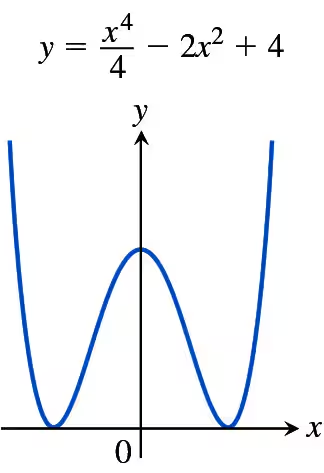
Identify the inflection points and local maxima and minima of the functions graphed in Exercises 1–8. Identify the open intervals on which the functions are differentiable and the graphs are concave up and concave down.
2. y=x^4/4-2x^2+4

Verified step by step guidance
1
To find the inflection points, local maxima, and minima, start by finding the first derivative of the function y = \(\frac{x^4}{4}\) - 2x^2 + 4. The first derivative, y', will help identify critical points where the slope is zero or undefined.
Calculate the first derivative: y' = \(\frac{d}{dx}\)(\(\frac{x^4}{4}\) - 2x^2 + 4). This simplifies to y' = x^3 - 4x.
Set the first derivative equal to zero to find critical points: x^3 - 4x = 0. Factor the equation: x(x^2 - 4) = 0, which gives x = 0, x = 2, and x = -2.
To determine if these critical points are local maxima, minima, or points of inflection, calculate the second derivative: y'' = \(\frac{d}{dx}\)(x^3 - 4x). This simplifies to y'' = 3x^2 - 4.
Evaluate the second derivative at the critical points: y''(0), y''(2), and y''(-2). If y'' > 0, the function is concave up (local minima); if y'' < 0, the function is concave down (local maxima); if y'' = 0, it may be an inflection point. Analyze the sign changes in y'' to identify intervals of concavity.

Verified video answer for a similar problem:

This video solution was recommended by our tutors as helpful for the problem above.
Video duration:
8m
Was this helpful?

Key Concepts

Here are the essential concepts you must grasp in order to answer the question correctly.

Inflection Points

Inflection points are points on a curve where the concavity changes, meaning the curve transitions from being concave up to concave down or vice versa. To find inflection points, one must analyze the second derivative of the function. If the second derivative changes sign at a point, that point is an inflection point.
Recommended video:
04:50
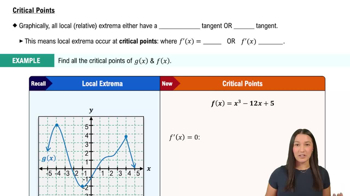
Critical Points

Local Maxima and Minima

Local maxima and minima are points where a function reaches a peak or a trough within a certain interval. These points can be identified using the first derivative test, where critical points (where the first derivative is zero or undefined) are evaluated to determine if they correspond to a maximum, minimum, or neither based on the sign of the derivative before and after the point.
Recommended video:
07:09
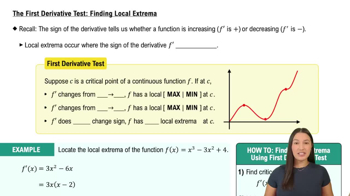
The First Derivative Test: Finding Local Extrema

Concavity and Differentiability

Concavity refers to the direction of the curvature of a function, determined by the sign of the second derivative. A function is concave up when its second derivative is positive and concave down when it is negative. Differentiability indicates that a function has a derivative at all points in an interval, which is essential for determining local extrema and concavity.
Recommended video:
05:59
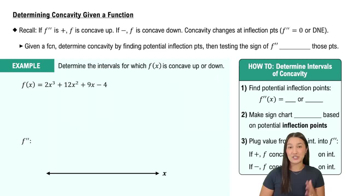
Determining Concavity Given a Function