Ch. 4 - Applications of Derivatives
Hass - Thomas' Calculus 15th Edition
Hass15th EditionThomas' CalculusISBN: 9780137616077Not the one you use?Change textbook
Chapter 4, Problem 4.3.61

Identifying Extrema


In Exercises 61 and 62, the graph of f' is given. Assume that f is continuous, and determine the x-values corresponding to local minima and local maxima.

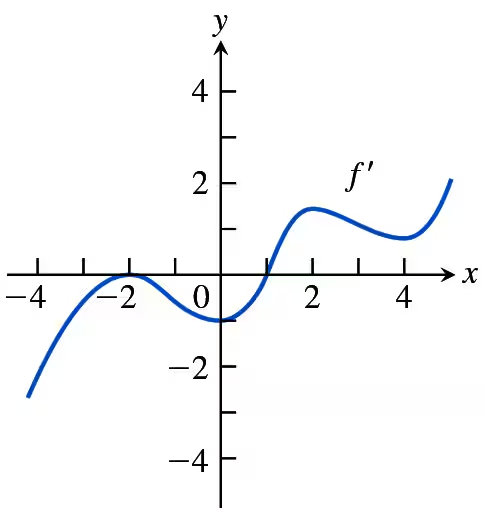
Graph of a blue curve labeled f prime showing changes in slope with x and y axes marked from -4 to 4.

Verified step by step guidance
1
Recall that the graph given is of the derivative \(f'(x)\) of the function \(f(x)\). To find local maxima and minima of \(f(x)\), we need to analyze the behavior of \(f'(x)\) around its zeros.
Identify the points where \(f'(x) = 0\) by locating the x-values where the graph of \(f'(x)\) crosses the x-axis. These points are candidates for local extrema of \(f(x)\).
Determine the sign change of \(f'(x)\) around each zero: - If \(f'(x)\) changes from positive to negative at a zero, then \(f(x)\) has a local maximum there. - If \(f'(x)\) changes from negative to positive at a zero, then \(f(x)\) has a local minimum there.
Examine the graph near each zero of \(f'(x)\) and note the sign of \(f'(x)\) just before and just after the zero to classify the extrema accordingly.
Summarize the x-values where \(f'(x)\) crosses zero and the corresponding sign changes to list the local minima and maxima of \(f(x)\).

Verified video answer for a similar problem:

This video solution was recommended by our tutors as helpful for the problem above.
Video duration:
4m
Was this helpful?

Key Concepts

Here are the essential concepts you must grasp in order to answer the question correctly.

Critical Points and Extrema

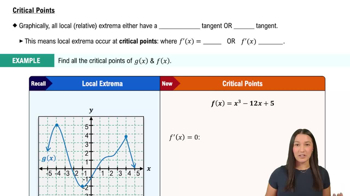
Critical points occur where the derivative f' is zero or undefined. These points are candidates for local maxima, minima, or saddle points. To identify local extrema, analyze the behavior of f' around these points, as they indicate where the slope of the original function f changes.
Recommended video:
04:50
Critical Points

First Derivative Test

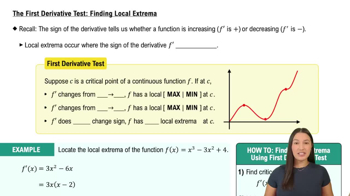
The First Derivative Test uses the sign changes of f' to determine local extrema. If f' changes from positive to negative at a critical point, f has a local maximum there. If f' changes from negative to positive, f has a local minimum. No sign change means no local extremum at that point.
Recommended video:
07:09
The First Derivative Test: Finding Local Extrema

Interpreting the Graph of f'

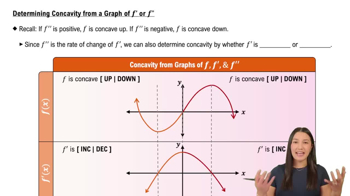
The graph of f' shows the slope of f at each x-value. Points where f' crosses the x-axis (f' = 0) are critical points. By observing whether f' goes from positive to negative or vice versa at these points, one can identify local maxima and minima of f without needing the explicit form of f.
Recommended video:
03:56
Determining Concavity from the Graph of f' or f''
Related Practice
Textbook Question

Identifying Extrema


In Exercises 61 and 62, the graph of f' is given. Assume that f is continuous, and determine the x-values corresponding to local minima and local maxima.


Textbook Question

Absolute Extrema on Finite Closed Intervals


In Exercises 21–36, find the absolute maximum and minimum values of each function on the given interval. Then graph the function. Identify the points on the graph where the absolute extrema occur, and include their coordinates.


f(x) = (2/3)x − 5, −2 ≤ x ≤ 3

Textbook Question

Finding Critical Points


In Exercises 41–50, determine all critical points and all domain endpoints for each function.


y = x² − 32√x

Textbook Question

Identify the inflection points and local maxima and minima of the functions graphed in Exercises 1–8. Identify the open intervals on which the functions are differentiable and the graphs are concave up and concave down.

2. y=x^4/4-2x^2+4

Textbook Question

Absolute Extrema on Finite Closed Intervals


In Exercises 21–36, find the absolute maximum and minimum values of each function on the given interval. Then graph the function. Identify the points on the graph where the absolute extrema occur, and include their coordinates.


f(t) = 2 − |t|, −1 ≤ t ≤ 3

Textbook Question

Each of Exercises 67–88 gives the first derivative of a continuous function y=f(x). Find y'' and then use Steps 2–4 of the graphing procedure described in this section to sketch the general shape of the graph of f.

77. y' = cot(θ/2), for 0 < θ < 2π