Ch. 4 - Applications of Derivatives
Hass - Thomas' Calculus 15th Edition
Hass15th EditionThomas' CalculusISBN: 9780137616077Not the one you use?Change textbook
Chapter 4, Problem 4.3.55a

Identifying Extrema


In Exercises 53–60:


a. Find the local extrema of each function on the given interval, and say where they occur.


f(x) = √3cos x + sin x, 0 ≤ x ≤ 2π

Verified step by step guidance
1
To find the local extrema of the function \( f(x) = \sqrt{3} \cos x + \sin x \) on the interval \( 0 \leq x \leq 2\pi \), start by finding the derivative of the function. The derivative \( f'(x) \) is given by \( f'(x) = -\sqrt{3} \sin x + \cos x \).
Set the derivative equal to zero to find the critical points: \( -\sqrt{3} \sin x + \cos x = 0 \). Rearrange this equation to \( \cos x = \sqrt{3} \sin x \).
Divide both sides by \( \cos x \) (assuming \( \cos x \neq 0 \)) to get \( 1 = \sqrt{3} \tan x \), which simplifies to \( \tan x = \frac{1}{\sqrt{3}} \).
Solve \( \tan x = \frac{1}{\sqrt{3}} \) for \( x \) within the interval \( 0 \leq x \leq 2\pi \). The solutions are \( x = \frac{\pi}{6} \) and \( x = \frac{7\pi}{6} \).
Evaluate the function \( f(x) \) at the critical points \( x = \frac{\pi}{6} \), \( x = \frac{7\pi}{6} \), and the endpoints \( x = 0 \) and \( x = 2\pi \) to determine the local extrema. Compare these values to identify the local maxima and minima.

Verified video answer for a similar problem:

This video solution was recommended by our tutors as helpful for the problem above.
Video duration:
7m
Was this helpful?

Key Concepts

Here are the essential concepts you must grasp in order to answer the question correctly.

Local Extrema

Local extrema refer to the points in a function where it reaches a local maximum or minimum value. These are points where the function changes direction, and they can be found by analyzing the first derivative. A local maximum occurs when the derivative changes from positive to negative, while a local minimum occurs when it changes from negative to positive.
Recommended video:
05:58
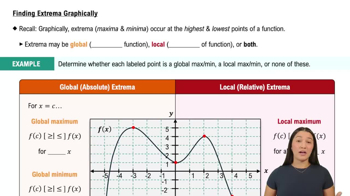
Finding Extrema Graphically

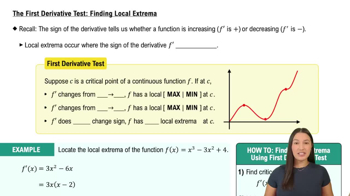
First Derivative Test

The first derivative test is a method used to identify local extrema of a function. By taking the derivative of the function and finding its critical points (where the derivative is zero or undefined), we can determine where the function's slope changes. Analyzing the sign of the derivative before and after these points helps identify whether they are local maxima or minima.
Recommended video:
07:09
The First Derivative Test: Finding Local Extrema

Trigonometric Functions

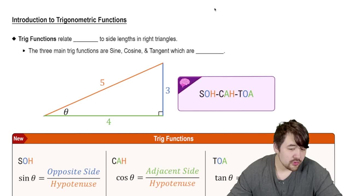
Trigonometric functions, such as sine and cosine, are periodic functions that describe oscillatory behavior. In the context of finding extrema, understanding their periodicity and behavior over specific intervals, like 0 to 2π, is crucial. These functions have known maximum and minimum values, which can help in determining the extrema of more complex functions involving them.
Recommended video:
6:04
Introduction to Trigonometric Functions