Ch. 4 - Applications of Derivatives
Hass - Thomas' Calculus 15th Edition
Hass15th EditionThomas' CalculusISBN: 9780137616077Not the one you use?Change textbook
Chapter 4, Problem 4.5.51a

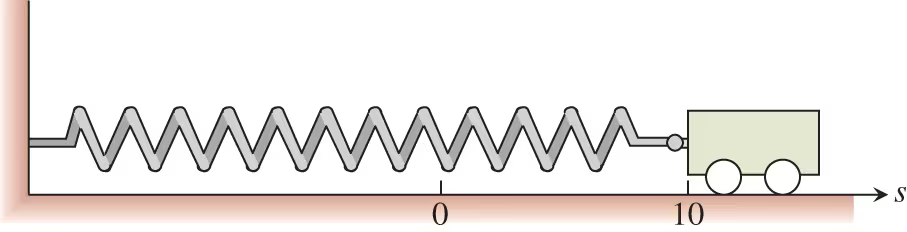
51. Frictionless cart A small frictionless cart, attached to the wall by a spring, is pulled 10 cm from its rest position and released at time t = 0 to roll back and forth for 4 sec. Its position at time t is s = 10 cos πt.

a. What is the cart's maximum speed? When is the cart moving that fast? Where is it then? What is the magnitude of the acceleration then?

Verified step by step guidance
1
To find the cart's maximum speed, we need to determine the derivative of the position function s(t) = 10 cos(πt) with respect to time t. This derivative will give us the velocity function v(t).
The velocity function v(t) is found by differentiating s(t) with respect to t: v(t) = ds/dt = -10π sin(πt).
The maximum speed occurs when the absolute value of the velocity is maximized. Since the sine function oscillates between -1 and 1, the maximum value of |v(t)| is 10π, which occurs when sin(πt) = ±1.
To find when the cart is moving at maximum speed, solve the equation sin(πt) = ±1. This occurs at t = 0.5, 1.5, 2.5, 3.5, etc., within the given time interval of 0 to 4 seconds.
To find the position and acceleration when the cart is moving at maximum speed, substitute t = 0.5 into the position function s(t) and the acceleration function a(t), where a(t) = dv/dt = -10π^2 cos(πt).

Verified video answer for a similar problem:

This video solution was recommended by our tutors as helpful for the problem above.
Video duration:
6m
Was this helpful?

Key Concepts

Here are the essential concepts you must grasp in order to answer the question correctly.

Simple Harmonic Motion

Simple harmonic motion (SHM) describes the motion of the cart as it oscillates back and forth. The position function s = 10 cos πt indicates that the cart's motion is periodic and sinusoidal, typical of SHM. The amplitude of 10 cm represents the maximum displacement from the rest position, and the angular frequency π determines the speed of oscillation.
Recommended video:
06:51
Derivatives Applied To Acceleration Example 2

Velocity in SHM

The velocity of an object in simple harmonic motion is the derivative of its position function with respect to time. For s = 10 cos πt, the velocity v(t) is given by v(t) = -10π sin πt. The maximum speed occurs when the sine function equals ±1, resulting in a maximum velocity magnitude of 10π cm/s.
Recommended video:
06:29
Derivatives Applied To Velocity

Acceleration in SHM

Acceleration in simple harmonic motion is the derivative of the velocity function or the second derivative of the position function. For s = 10 cos πt, the acceleration a(t) is a(t) = -10π² cos πt. The magnitude of acceleration is maximum when the cosine function equals ±1, which occurs at the maximum displacement points.
Recommended video:
06:15
Derivatives Applied To Acceleration