
Textbook Question
Finding Antiderivatives
In Exercises 1–16, find an antiderivative for each function. Do as many as you can mentally. Check your answers by differentiation.
(2/3)x⁻¹ᐟ³
1
views

 Verified step by step guidance
 04:50
04:50
 6:04
6:04 5:02
5:02Finding Antiderivatives
In Exercises 1–16, find an antiderivative for each function. Do as many as you can mentally. Check your answers by differentiation.
(2/3)x⁻¹ᐟ³
51. Frictionless cart A small frictionless cart, attached to the wall by a spring, is pulled 10 cm from its rest position and released at time t = 0 to roll back and forth for 4 sec. Its position at time t is s = 10 cos πt.
a. What is the cart's maximum speed? When is the cart moving that fast? Where is it then? What is the magnitude of the acceleration then?
Applications
Suppose that f(x) = d/dx (1 − √x) and g(x) = d/dx (x + 2).
Find:
∫f(x) dx
Analyzing Functions from Derivatives
Answer the following questions about the functions whose derivatives are given in Exercises 1–14:
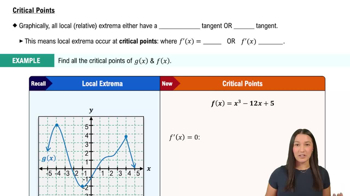
a. What are the critical points of f?
f′(x) = (x − 1)²(x + 2)
Finding Antiderivatives
In Exercises 1–16, find an antiderivative for each function. Do as many as you can mentally. Check your answers by differentiation.
2x
Identifying Extrema
In Exercises 41–52:
a. Identify the function’s local extreme values in the given domain, and say where they occur.
f(t) = t³ − 3t², −∞ < t ≤ 3