
Textbook Question
Applications
Suppose that f(x) = d/dx (1 − √x) and g(x) = d/dx (x + 2).
Find:
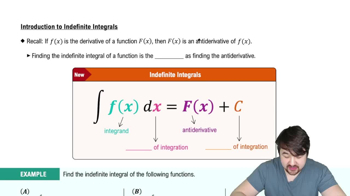
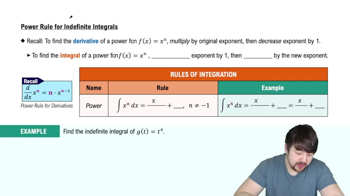
∫f(x) dx

 Verified step by step guidance
 05:04
05:04
 04:04
04:04 05:53
05:53Applications
Suppose that f(x) = d/dx (1 − √x) and g(x) = d/dx (x + 2).
Find:
∫f(x) dx
Analyzing Functions from Derivatives
Answer the following questions about the functions whose derivatives are given in Exercises 1–14:
a. What are the critical points of f?
f′(x) = (x − 1)²(x + 2)
Analyzing Functions from Derivatives
Answer the following questions about the functions whose derivatives are given in Exercises 1–14:
a. What are the critical points of f?
f′(x) = 1− 4/x², x ≠ 0
Finding Antiderivatives
In Exercises 1–16, find an antiderivative for each function. Do as many as you can mentally. Check your answers by differentiation.
2x
Identifying Extrema
In Exercises 41–52:
a. Identify the function’s local extreme values in the given domain, and say where they occur.
f(t) = t³ − 3t², −∞ < t ≤ 3
Analyzing Functions from Derivatives
Answer the following questions about the functions whose derivatives are given in Exercises 1–14:
a. What are the critical points of f?
f′(x) = (x − 1)(x + 2)(x − 3)