
Textbook Question
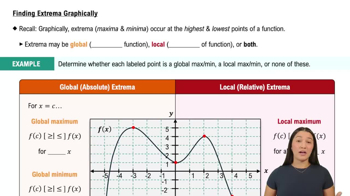
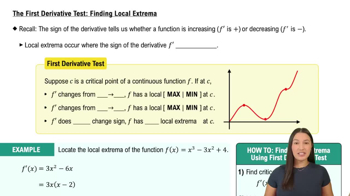
Identifying Extrema
In Exercises 41–52:
a. Identify the function’s local extreme values in the given domain, and say where they occur.
g(x) = −x² − 6x − 9,−4 ≤ x < ∞

 Verified step by step guidance
 05:58
05:58
 07:09
07:09 06:35
06:35Identifying Extrema
In Exercises 41–52:
a. Identify the function’s local extreme values in the given domain, and say where they occur.
g(x) = −x² − 6x − 9,−4 ≤ x < ∞
Theory and Examples
In Exercises 51 and 52, give reasons for your answers.
Let f(x) = (x − 2)²ᐟ³.
a. Does f′(2) exist?
Finding Antiderivatives
In Exercises 1–16, find an antiderivative for each function. Do as many as you can mentally. Check your answers by differentiation.
csc x cot x
Identifying Extrema
In Exercises 63 and 64, the graph of f' is given. Assume that f has domain (-2, 2).
" style="" width="220">
a. Either use the graph to determine which intervals f is increasing on and which intervals f is decreasing on, or explain why this information cannot be determined from the graph.
Finding Antiderivatives
In Exercises 1–16, find an antiderivative for each function. Do as many as you can mentally. Check your answers by differentiation.
(3/2)√x
Identifying Extrema
In Exercises 53–60:
a. Find the local extrema of each function on the given interval, and say where they occur.
f(x) = √3cos x + sin x, 0 ≤ x ≤ 2π