
Textbook Question
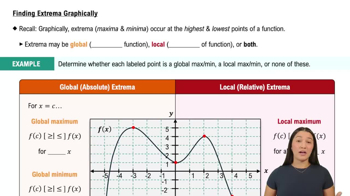
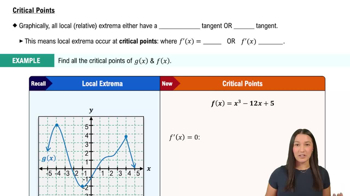
110. Suppose the derivative of the function y = f(x) is
y'=(x-1)^22(x-2)(x-4).
At what points, if any, does the graph of f have a local minimum, local maximum, or
point of inflection?
1
views

 Verified step by step guidance
 05:58
05:58
 04:50
04:50 5:53
5:53110. Suppose the derivative of the function y = f(x) is
y'=(x-1)^22(x-2)(x-4).
At what points, if any, does the graph of f have a local minimum, local maximum, or
point of inflection?
Checking the Mean Value Theorem
Which of the functions in Exercises 7–12 satisfy the hypotheses of the Mean Value Theorem on the given interval, and which do not? Give reasons for your answers.
f(x) = {x² − x, −2 ≤ x ≤−1
2x² − 3x − 3, −1 < x ≤ 0
56. Airplane landing path An airplane is flying at altitude H when it begins its descent to an airport runway that is at horizontal ground distance L from the airplane, as shown in the accompanying figure. Assume that the landing path of the airplane is the graph of a cubic polynomial function y = ax^3+bx^2+cx+d, where y(-L)= H and y(0)=0.
a. What is dy/dx at x = 0?
b. What is dy/dx at x = -L?
c. Use the values for dy/dx at x = 0 and x =- L together with y(0) = 0 and y(-L) = H to show that y(x)=H[2(x/L)^3+3(x/L)^2]
Identifying Extrema
In Exercises 19–40:
a. Find the open intervals on which the function is increasing and those on which it is decreasing.
b. Identify the function’s local extreme values, if any, saying where they occur.
f(x) = x − 6√(x − 1)
Roots (Zeros)
Show that the functions in Exercises 19–26 have exactly one zero in the given interval.
g(t) = √t + √(1 + t) − 4, (0, ∞)
Identifying Extrema
In Exercises 19–40:
a. Find the open intervals on which the function is increasing and those on which it is decreasing.
b. Identify the function’s local extreme values, if any, saying where they occur.
g(x) = x√8 − x²