
Ch. 4 - Applications of Derivatives
Hass - Thomas' Calculus 15th Edition
Hass15th EditionThomas' CalculusISBN: 9780137616077Not the one you use?Change textbook
Chapter 4, Problem 4.4.110

110. Suppose the derivative of the function y = f(x) is
y'=(x-1)^22(x-2)(x-4).
At what points, if any, does the graph of f have a local minimum, local maximum, or
point of inflection?

Verified step by step guidance
1
Step 1: Identify critical points by setting the derivative y' = (x-1)^2 * 2(x-2)(x-4) equal to zero. Solve for x to find the values where the slope of the tangent line is zero or undefined.
Step 2: Analyze the multiplicity of the factors in y'. For example, (x-1)^2 has even multiplicity, which means it does not change sign at x = 1. Factors with odd multiplicity, such as (x-2) and (x-4), indicate sign changes at x = 2 and x = 4.
Step 3: Use the first derivative test to determine whether each critical point corresponds to a local minimum, local maximum, or neither. Examine the sign of y' on intervals around each critical point (e.g., test values in intervals like (−∞, 1), (1, 2), (2, 4), and (4, ∞)).
Step 4: To find points of inflection, compute the second derivative y'' by differentiating y' = (x-1)^2 * 2(x-2)(x-4). Set y'' equal to zero and solve for x to identify where the concavity changes.
Step 5: Verify the nature of each point of inflection by checking the sign of y'' on intervals around the solutions obtained in Step 4. Points where y'' changes sign indicate points of inflection.

Verified video answer for a similar problem:

This video solution was recommended by our tutors as helpful for the problem above.
Video duration:
4m
Was this helpful?

Key Concepts

Here are the essential concepts you must grasp in order to answer the question correctly.

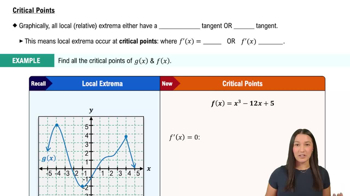
Derivative and Critical Points

The derivative of a function, denoted as y' or f'(x), represents the rate of change of the function at any point. Critical points occur where the derivative is zero or undefined, indicating potential local maxima, minima, or points of inflection. To find these points, we set the derivative equal to zero and solve for x.
Recommended video:
04:50
Critical Points

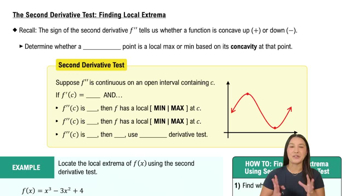
Second Derivative Test

The second derivative test is a method used to determine the nature of critical points. If the second derivative, f''(x), is positive at a critical point, the function has a local minimum; if negative, it has a local maximum. If the second derivative is zero, the test is inconclusive, and further analysis is needed.
Recommended video:
06:02
The Second Derivative Test: Finding Local Extrema

Points of Inflection

Points of inflection occur where the concavity of the function changes, which can be identified by analyzing the second derivative. Specifically, a point of inflection exists where f''(x) changes sign, indicating a transition from concave up to concave down or vice versa. These points are important for understanding the overall shape of the graph.
Recommended video:
04:50
Critical Points
Related Practice
Textbook Question

56. Airplane landing path An airplane is flying at altitude H when it begins its descent to an airport runway that is at horizontal ground distance L from the airplane, as shown in the accompanying figure. Assume that the landing path of the airplane is the graph of a cubic polynomial function y = ax^3+bx^2+cx+d, where y(-L)= H and y(0)=0.

a. What is dy/dx at x = 0?

b. What is dy/dx at x = -L?

c. Use the values for dy/dx at x = 0 and x =- L together with y(0) = 0 and y(-L) = H to show that y(x)=H[2(x/L)^3+3(x/L)^2]

1
views
Textbook Question

Absolute Extrema on Finite Closed Intervals


In Exercises 21–36, find the absolute maximum and minimum values of each function on the given interval. Then graph the function. Identify the points on the graph where the absolute extrema occur, and include their coordinates.


g(x) = √(4 − x²), −2 ≤ x ≤ 1

Textbook Question

Identifying Extrema


In Exercises 19–40:


a. Find the open intervals on which the function is increasing and those on which it is decreasing.


b. Identify the function’s local extreme values, if any, saying where they occur.


f(x) = x − 6√(x − 1)

Textbook Question

Identifying Extrema


In Exercises 15–18:


a. Find the open intervals on which the function is increasing and those on which it is decreasing.


b. Identify the function’s local and absolute extreme values, if any, saying where they occur.


Textbook Question

26. Constructing cylinders Compare the answers to the following two construction problems.

a. A rectangular sheet of perimeter 36 cm and dimensions x cm by y cm is to be rolled into a cylinder as shown in part (a) of the figure. What values of x and y give the largest volume?

b. The same sheet is to be revolved about one of the sides of length y to sweep out the cylinder as shown in part (b) of the figure. What values of x and y give the largest volume?

" style="" width="350">

Textbook Question

Roots (Zeros)


Show that the functions in Exercises 19–26 have exactly one zero in the given interval.


g(t) = √t + √(1 + t) − 4, (0, ∞)