Back
Back
Problem 3.2.56
Tangent line to y = √x Does any tangent line to the curve y = √x cross the x-axis at x = −1? If so, find an equation for the line and the point of tangency. If not, why not?
Problem 3.7.30
In Exercises 29 and 30, find the slope of the curve at the given points.
(x² + y²)² = (x – y)² at (1,0) and (1,–1)
Problem 3.86
In Exercises 83–88, find equations for the lines that are tangent, and the lines that are normal, to the curve at the given point.
(y - x)² = 2x + 4, (6, 2)
Problem 3.3.56
For Exercises 55 and 56, evaluate each limit by first converting each to a derivative at a particular x-value.
lim (x → −1) (x²/⁹ − 1) / (x + 1)
Problem 3.6.74
If r = sin(f(t)), f(0) = π/3, and f'(0) = 4, then what is dr/dt at t = 0?
Problem 3.7.29
In Exercises 29 and 30, find the slope of the curve at the given points.
y² + x² = y⁴ – 2x at (–2,1) and (–2,–1)
Problem 3.9.18
Derivatives in Differential Form
In Exercises 17–28, find dy.
y = x√(1 − x²)
Problem 3.77
Find the points on the curve y = tan x, -π/2 < x < π/2, where the normal line is parallel to the line y = -x/2. Sketch the curve and normal lines together, labeling each with its equation.
Problem 3.5.51
Is there a value of c that will make
f(x) = { (sin²(3x)) / x², x ≠ 0
c, x = 0
continuous at x = 0? Give reasons for your answer.
Problem 3.9.37
Differential Estimates of Change
In Exercises 35–40, write a differential formula that estimates the given change in volume or surface area.
The change in the surface area S = 6x² of a cube when the edge lengths change from x₀ to x₀ + dx
Problem 3.11
Find the derivatives of the functions in Exercises 1–42.
𝔂 = 2 tan² x - sec² x
Problem 3.6.77
Find ds/dt when θ = 3π/2 if s = cosθ and dθ/dt = 5.
Problem 3.9.20
Derivatives in Differential Form
In Exercises 17–28, find dy.
y = (2√x)/(3(1 + √x))
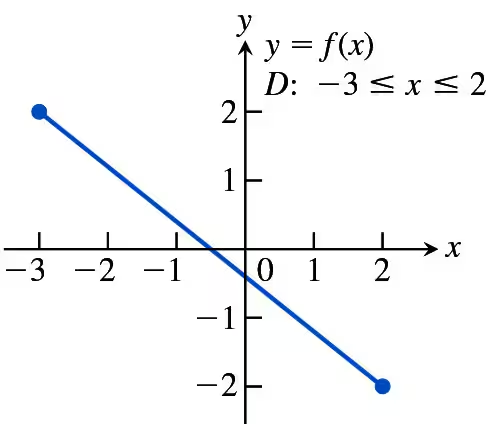
Problem 3.2.45a
Differentiability and Continuity on an Interval
Each figure in Exercises 45–50 shows the graph of a function over a closed interval D. At what domain points does the function appear to be
a. differentiable?
Give reasons for your answers.
Problem 3.5.53a
By computing the first few derivatives and looking for a pattern, find the following derivatives.
a. d⁹⁹⁹/dx⁹⁹⁹ (cos x)
Problem 3.8.19a
Area The area A of a triangle with sides of lengths a and b enclosing an angle of measure θ is
A = (1/2) ab sinθ.
a. How is dA/dt related to dθ/dt if a and b are constant?
Problem 3.2.60a
a. Let f(x) be a function satisfying |f(x)| ≤ x² for −1 ≤ x ≤ 1. Show that f is differentiable at x = 0 and find f′(0).
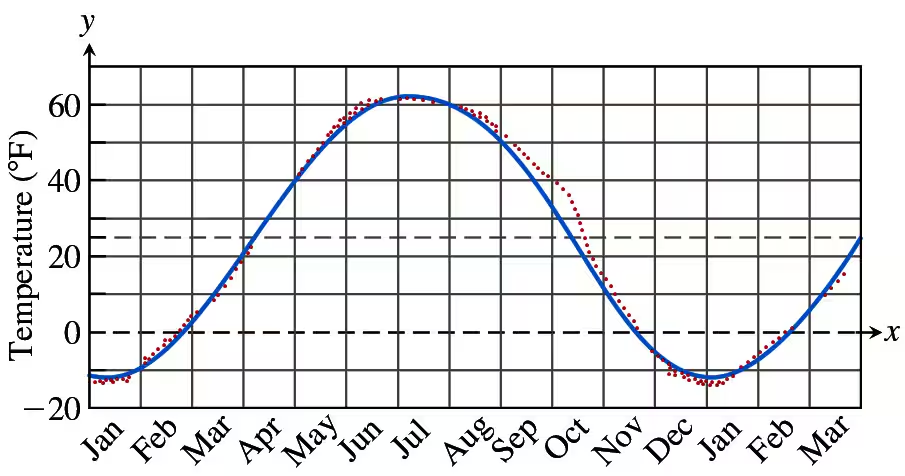
Problem 3.6.86a
Temperatures in Fairbanks, Alaska The graph in the accompanying figure shows the average Fahrenheit temperature in Fairbanks, Alaska, during a typical 365-day year. The equation that approximates the temperature on day x is
y = 37 sin[(2π/365)(x − 101)] + 25
and is graphed in the accompanying figure.
a. On what day is the temperature increasing the fastest?
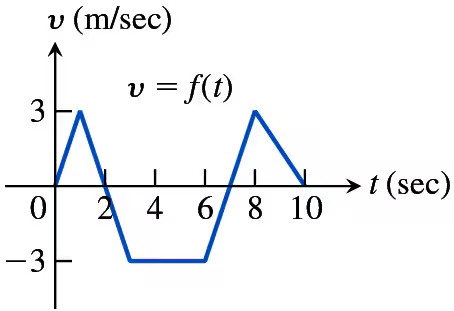
Problem 3.4.15a
The accompanying figure shows the velocity v = ds/dt = f(t) (m/sec) of a body moving along a coordinate line.
a. When does the body reverse direction?
Problem 3.9.14a
Use the linear approximation (1 + x)ᵏ ≈ 1 + kx to find an approximation for the function f(x) for values of x near zero.
a. f(x) = (1 − x)⁶
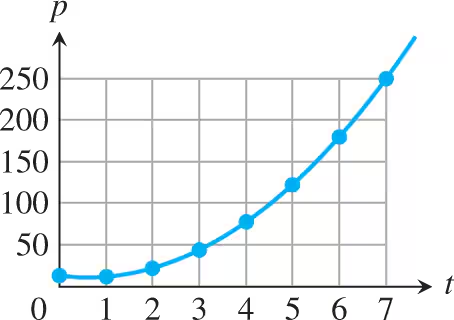
Problem 3.1.23a
Interpreting Derivative Values
Growth of yeast cells In a controlled laboratory experiment, yeast cells are grown in an automated cell culture system that counts the number P of cells present at hourly intervals. The number after t hours is shown in the accompanying figure.
a. Explain what is meant by the derivative P'(5). What are its units?
Problem 3.8.32a
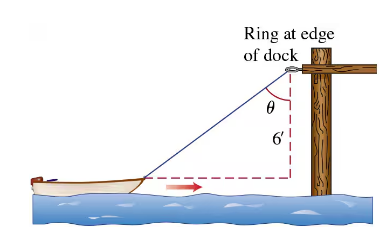
Hauling in a dinghy A dinghy is pulled toward a dock by a rope from the bow through a ring on the dock 6 ft above the bow. The rope is hauled in at the rate of 2 ft/sec.
a. How fast is the boat approaching the dock when 10 ft of rope are out?
Problem 3.9.45a
The radius r of a circle is measured with an error of at most 2%. What is the maximum corresponding percentage error in computing the circle’s
a. circumference?
Problem 3.5.33a
Find y'' if:
a. y = csc x
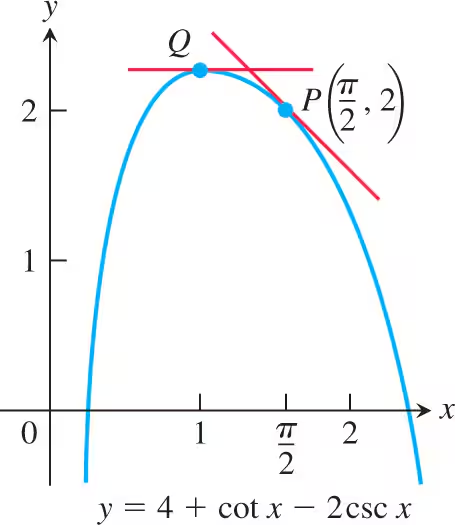
Problem 3.5.47a
In Exercises 47 and 48, find an equation for
(a) the tangent line to the curve at P
Problem 3.9.55a
Quadratic approximations
a. Let Q(x) = b₀ + b₁(x − a) + b₂(x − a)² be a quadratic approximation to f(x) at x = a with these properties:
i. Q(a) = f(a)
ii. Q′(a) = f′(a)
iii. Q″(a) = f″(a).
Determine the coefficients b₀, b₁, and b₂.
Problem 3.1.24a
Interpreting Derivative Values
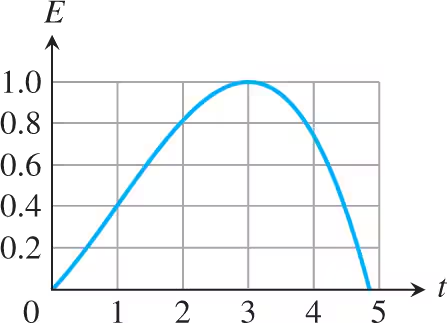
Effectiveness of a drug On a scale from 0 to 1, the effectiveness E of a pain-killing drug t hours after entering the bloodstream is displayed in the accompanying figure.
a. At what times does the effectiveness appear to be increasing? What is true about the derivative at those times?
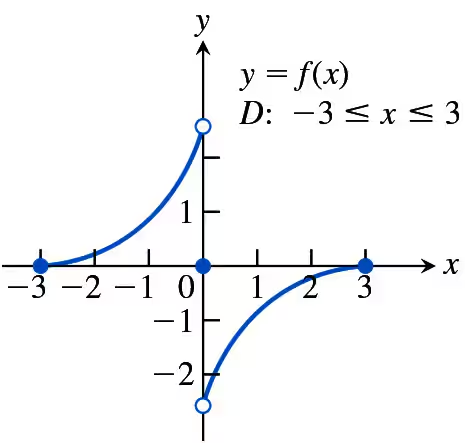
Problem 3.2.47a
Differentiability and Continuity on an Interval
Each figure in Exercises 45–50 shows the graph of a function over a closed interval D. At what domain points does the function appear to be
a. differentiable?
Give reasons for your answers.
Problem 3.8.18a
Diagonals If x, y, and z are lengths of the edges of a rectangular box, then the common length of the box’s diagonals is s = √(x² + y² + z²).
a. Assuming that x, y, and z are differentiable functions of t, how is ds/dt related to dx/dt, dy/dt, and dz/dt?
Problem 3.9.15a
Faster than a calculator Use the approximation (1 + x)ᵏ ≈ 1 + kx to estimate the following.
a. (1.0002)⁵⁰