
Textbook Question
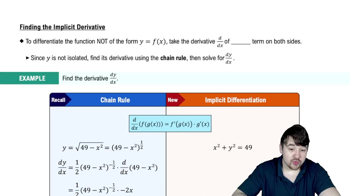
In Exercises 53 and 54, find both dy/dx (treating y as a differentiable function of x) and dx/dy (treating x as a differentiable function of y). How do dy/dx and dx/dy seem to be related?
54. x³ + y² = sin²y

 Verified step by step guidance
 05:14
05:14
 05:02
05:02 04:50
04:50In Exercises 53 and 54, find both dy/dx (treating y as a differentiable function of x) and dx/dy (treating x as a differentiable function of y). How do dy/dx and dx/dy seem to be related?
54. x³ + y² = sin²y
Derivative Calculations
In Exercises 1–12, find the first and second derivatives.
y = x² + x + 8
Slopes and Tangent Lines
In Exercises 1–4, use the grid and a straight edge to make a rough estimate of the slope of the curve (in y-units per x-unit) at the points P₁ and P₂.
Slopes, Tangent Lines, and Normal Lines
In Exercises 31–40, verify that the given point is on the curve and find the lines that are (a) tangent and (b) normal to the curve at the given point.
y = 2 sin(πx – y), (1,0)
If L = √(x² + y²), dx/dt = –1, and dy/dt = 3, find dL/dt when x = 5 and y = 12.
Falling meteorite The velocity of a heavy meteorite entering Earth’s atmosphere is inversely proportional to √s when it is s km from Earth’s center. Show that the meteorite’s acceleration is inversely proportional to s².