Ch. 3 - Derivatives
Hass - Thomas' Calculus 15th Edition
Hass15th EditionThomas' CalculusISBN: 9780137616077Not the one you use?Change textbook
Chapter 3, Problem 3.9.47

Tolerance The height and radius of a right circular cylinder are equal, so the cylinder’s volume is V = πh³. The volume is to be calculated with an error of no more than 1% of the true value. Find approximately the greatest error that can be tolerated in the measurement of h, expressed as a percentage of h.

Verified step by step guidance
1
Start by understanding the formula for the volume of the cylinder, which is given as V = πh³. Here, h is both the height and the radius of the cylinder.
To find the error in the volume, use the concept of differentials. The differential of the volume, dV, can be expressed as dV = 3πh² dh, where dh is the error in the measurement of h.
Since the problem states that the error in the volume should be no more than 1% of the true value, set up the inequality: |dV| ≤ 0.01V. Substitute V = πh³ into the inequality to get |3πh² dh| ≤ 0.01πh³.
Simplify the inequality by dividing both sides by πh², resulting in |3 dh| ≤ 0.01 h.
Solve the inequality for dh to find the greatest error in h that can be tolerated. Express this error as a percentage of h by dividing both sides by h, resulting in |dh/h| ≤ 0.01/3. This gives the percentage error in h.

Verified video answer for a similar problem:

This video solution was recommended by our tutors as helpful for the problem above.
Video duration:
3m
Was this helpful?

Key Concepts

Here are the essential concepts you must grasp in order to answer the question correctly.

Volume of a Cylinder

The volume of a right circular cylinder is calculated using the formula V = πr²h, where r is the radius and h is the height. In this problem, the height and radius are equal, simplifying the formula to V = πh³. Understanding this formula is crucial for determining how changes in h affect the volume.
Recommended video:
04:48
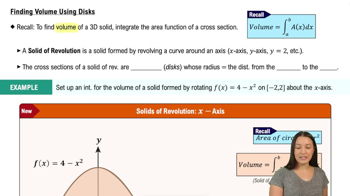
Finding Volume Using Disks

Differential Calculus

Differential calculus involves finding the rate at which a function changes. In this context, it helps determine how small changes in the height h affect the volume V. By using the derivative dV/dh, we can approximate the change in volume for a small change in h, which is essential for calculating the error tolerance.
Recommended video:
06:11
Fundamental Theorem of Calculus Part 1

Error Propagation

Error propagation is the process of determining the uncertainty in a calculated result based on the uncertainties in the measurements. Here, it involves calculating the maximum permissible error in h that results in a volume error of no more than 1%. This concept is key to ensuring the volume calculation remains within the specified tolerance.
Recommended video:
04:57
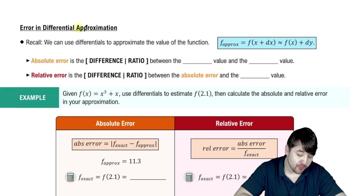
Determining Error and Relative Error