
Tolerance The height and radius of a right circular cylinder are equal, so the cylinder’s volume is V = πh³. The volume is to be calculated with an error of no more than 1% of the true value. Find approximately the greatest error that can be tolerated in the measurement of h, expressed as a percentage of h.
Ch. 3 - Derivatives
Chapter 3, Problem 3.1.18
In Exercises 11–18, find the slope of the function’s graph at the given point. Then find an equation for the line tangent to the graph there.
f(x) = √(x + 1), (8, 3)
Verified step by step guidance1
To find the slope of the function's graph at the given point, we need to compute the derivative of the function f(x) = √(x + 1). The derivative, f'(x), represents the slope of the tangent line at any point x.
Use the chain rule to differentiate f(x) = (x + 1)^(1/2). The chain rule states that if you have a composite function g(h(x)), the derivative is g'(h(x)) * h'(x). Here, g(u) = u^(1/2) and h(x) = x + 1.
Differentiate g(u) = u^(1/2) to get g'(u) = (1/2)u^(-1/2). Differentiate h(x) = x + 1 to get h'(x) = 1. Therefore, f'(x) = (1/2)(x + 1)^(-1/2) * 1.
Evaluate the derivative at the given point x = 8 to find the slope of the tangent line. Substitute x = 8 into f'(x) to get f'(8) = (1/2)(8 + 1)^(-1/2).
Now, use the point-slope form of a line to find the equation of the tangent line. The point-slope form is y - y1 = m(x - x1), where m is the slope found in the previous step, and (x1, y1) is the given point (8, 3). Substitute these values into the equation to find the tangent line.

Verified video answer for a similar problem:
This video solution was recommended by our tutors as helpful for the problem above.
Video duration:
7mWas this helpful?
Key Concepts
Here are the essential concepts you must grasp in order to answer the question correctly.
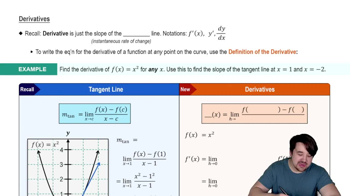
Derivative
The derivative of a function at a point provides the slope of the tangent line to the function's graph at that point. It is a fundamental concept in calculus that measures how a function changes as its input changes. For the function f(x) = √(x + 1), the derivative can be found using the power rule and chain rule.
Recommended video:
Derivatives
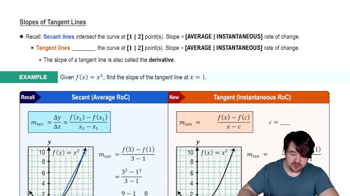
Tangent Line
A tangent line to a curve at a given point is a straight line that just 'touches' the curve at that point. It has the same slope as the curve at that point, which is given by the derivative. The equation of the tangent line can be found using the point-slope form of a line, y - y₁ = m(x - x₁), where m is the slope and (x₁, y₁) is the point of tangency.
Recommended video:
Slopes of Tangent Lines
Point-Slope Form
The point-slope form of a linear equation is used to find the equation of a line when you know the slope and a point on the line. It is expressed as y - y₁ = m(x - x₁), where m is the slope and (x₁, y₁) is a specific point on the line. This form is particularly useful for writing the equation of a tangent line once the slope is determined from the derivative.
Recommended video:
Guided course
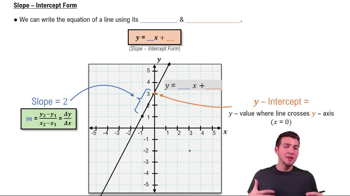
Slope-Intercept Form
Related Practice
Textbook Question
Textbook Question
Tangent line to y = √x Does any tangent line to the curve y = √x cross the x-axis at x = −1? If so, find an equation for the line and the point of tangency. If not, why not?
Textbook Question
Differentiating Implicitly
Use implicit differentiation to find dy/dx in Exercises 1–14.
x³ + y³ = 18xy
Textbook Question
Differentiating Implicitly
Use implicit differentiation to find dy/dx in Exercises 1–14.
x²y + xy² = 6
Textbook Question
Derivatives
In Exercises 1–18, find dy/dx.
f(x) = x³ sin x cos x
Textbook Question
In Exercises 5–10, find an equation for the tangent line to the curve at the given point. Then sketch the curve and tangent line together.
y = 4 − x², (−1, 3)
