
Tolerance The height and radius of a right circular cylinder are equal, so the cylinder’s volume is V = πh³. The volume is to be calculated with an error of no more than 1% of the true value. Find approximately the greatest error that can be tolerated in the measurement of h, expressed as a percentage of h.
Ch. 3 - Derivatives
Chapter 3, Problem 3.5.17
Derivatives
In Exercises 1–18, find dy/dx.
f(x) = x³ sin x cos x
Verified step by step guidance1
Identify the function f(x) = x³ sin(x) cos(x) and recognize that it is a product of three functions: u(x) = x³, v(x) = sin(x), and w(x) = cos(x).
Apply the product rule for derivatives, which states that if you have a product of functions u(x), v(x), and w(x), then the derivative is given by: (uvw)' = u'vw + uv'w + uvw'.
Calculate the derivative of each individual function: u'(x) = 3x², v'(x) = cos(x), and w'(x) = -sin(x).
Substitute these derivatives into the product rule formula: dy/dx = (3x²)(sin(x))(cos(x)) + (x³)(cos(x))(cos(x)) + (x³)(sin(x))(-sin(x)).
Simplify the expression by combining like terms and using trigonometric identities if necessary to express the derivative in its simplest form.

Verified video answer for a similar problem:
This video solution was recommended by our tutors as helpful for the problem above.
Video duration:
2mWas this helpful?
Key Concepts
Here are the essential concepts you must grasp in order to answer the question correctly.
Derivatives
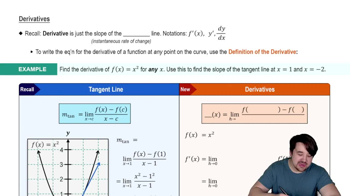
A derivative represents the rate of change of a function with respect to its variable. It is a fundamental concept in calculus that provides information about the slope of the tangent line to the curve of the function at any given point. The notation dy/dx indicates the derivative of y with respect to x, and it can be computed using various rules such as the power rule, product rule, and chain rule.
Recommended video:
Derivatives
Product Rule
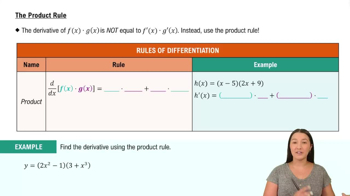
The product rule is a formula used to find the derivative of the product of two functions. If u(x) and v(x) are two differentiable functions, the product rule states that the derivative of their product is given by d(uv)/dx = u'v + uv', where u' and v' are the derivatives of u and v, respectively. This rule is essential for differentiating functions that are products of simpler functions, such as the given function f(x) = x³ sin x cos x.
Recommended video:
The Product Rule
Trigonometric Functions
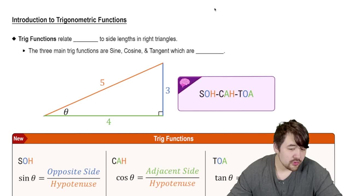
Trigonometric functions, such as sine (sin) and cosine (cos), are fundamental in calculus, especially when dealing with derivatives. These functions have specific derivatives: the derivative of sin(x) is cos(x), and the derivative of cos(x) is -sin(x). Understanding these derivatives is crucial when applying the product rule to functions that involve trigonometric components, as seen in the function f(x) = x³ sin x cos x.
Recommended video:
Introduction to Trigonometric Functions
Related Practice
Textbook Question
Textbook Question
In Exercises 11–18, find the slope of the function’s graph at the given point. Then find an equation for the line tangent to the graph there.
f(x) = √(x + 1), (8, 3)
Textbook Question
Derivatives
In Exercises 27–32, find dp/dq.
p = (q sin q) / (q² − 1)
Textbook Question
Finding Derivative Values
In Exercises 67–72, find the value of (f ∘ g)' at the given value of x.
f(u) = 1 − (1/u), u = g(x) = (1 / (1 − x)), x = −1
1
views
Textbook Question
Find the derivatives of the functions in Exercises 1–42.
𝓻 = ( sin θ )²
( cos θ - 1 )
Textbook Question
In Exercises 5–10, find an equation for the tangent line to the curve at the given point. Then sketch the curve and tangent line together.
y = 4 − x², (−1, 3)
