Parallel tangent lines Find the two points where the curve x² + xy + y² = 7 crosses the x-axis, and show that the tangent lines to the curve at these points are parallel. What is the common slope of these tangent lines?

Ch. 3 - Derivatives
Chapter 3, Problem 3.1.20
In Exercises 19–22, find the slope of the curve at the point indicated.
y = x³ − 2x + 7, x = −2
Verified step by step guidance1
To find the slope of the curve at a given point, we need to determine the derivative of the function. The function given is \( y = x^3 - 2x + 7 \).
Differentiate the function with respect to \( x \). The derivative of \( y = x^3 - 2x + 7 \) is \( \frac{dy}{dx} = 3x^2 - 2 \).
Now that we have the derivative, we can find the slope of the curve at any point \( x \) by substituting the \( x \)-value into the derivative.
Substitute \( x = -2 \) into the derivative \( \frac{dy}{dx} = 3x^2 - 2 \) to find the slope at this specific point.
Calculate \( 3(-2)^2 - 2 \) to determine the slope of the curve at \( x = -2 \).

Verified video answer for a similar problem:
This video solution was recommended by our tutors as helpful for the problem above.
Video duration:
5mWas this helpful?
Key Concepts
Here are the essential concepts you must grasp in order to answer the question correctly.
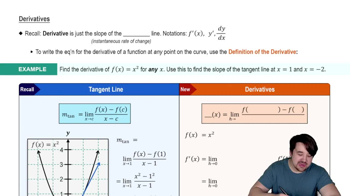
Derivative
The derivative of a function measures the rate at which the function's value changes as its input changes. It is defined as the limit of the average rate of change of the function over an interval as the interval approaches zero. In calculus, the derivative is often denoted as f'(x) or dy/dx, and it provides the slope of the tangent line to the curve at any given point.
Recommended video:
Derivatives
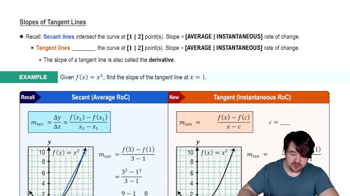
Slope of a Curve
The slope of a curve at a specific point is determined by the derivative of the function evaluated at that point. It represents the instantaneous rate of change of the function's value with respect to its input. For the function y = x³ − 2x + 7, finding the slope at x = -2 involves calculating the derivative and substituting -2 into that derivative.
Recommended video:
Slopes of Tangent Lines
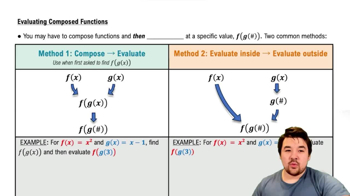
Evaluating Functions
Evaluating a function involves substituting a specific value for the variable in the function's expression to find the corresponding output. In this context, after finding the derivative of the function, we will evaluate it at x = -2 to determine the slope of the curve at that point. This process is essential for obtaining numerical results from algebraic expressions.
Recommended video:
Evaluating Composed Functions
Related Practice
Textbook Question
Textbook Question
In Exercises 83–88, find equations for the lines that are tangent, and the lines that are normal, to the curve at the given point.
__
x + √xy = 6, (4, 1)
Textbook Question
Derivatives in Differential Form
In Exercises 17–28, find dy.
y = (2√x)/(3(1 + √x))
Textbook Question
The edge x of a cube is measured with an error of at most 0.5%. What is the maximum corresponding percentage error in computing the cube’s
b. volume?
Textbook Question
Derivatives in Differential Form
In Exercises 17–28, find dy.
xy² − 4x³/² − y = 0
Textbook Question
Power Rule for negative integers Use the Derivative Quotient Rule to prove the Power Rule for negative integers, that is,
d/dx (x⁻ᵐ) = −mx⁻ᵐ⁻¹
where m is a positive integer.