Parallel tangent lines Find the two points where the curve x² + xy + y² = 7 crosses the x-axis, and show that the tangent lines to the curve at these points are parallel. What is the common slope of these tangent lines?

Ch. 3 - Derivatives
Chapter 3, Problem 3.3.64
Power Rule for negative integers Use the Derivative Quotient Rule to prove the Power Rule for negative integers, that is,
d/dx (x⁻ᵐ) = −mx⁻ᵐ⁻¹
where m is a positive integer.
Verified step by step guidance1
Start by expressing the function x^(-m) as a fraction: x^(-m) = 1/x^m.
Apply the Quotient Rule for derivatives, which states that if you have a function in the form of u/v, the derivative is (v * du/dx - u * dv/dx) / v^2.
Set u = 1 and v = x^m. Then, compute the derivatives: du/dx = 0 and dv/dx = m * x^(m-1).
Substitute these into the Quotient Rule formula: (x^m * 0 - 1 * m * x^(m-1)) / (x^m)^2.
Simplify the expression: -m * x^(m-1) / x^(2m) = -m * x^(-m-1), which proves the Power Rule for negative integers.

Verified video answer for a similar problem:
This video solution was recommended by our tutors as helpful for the problem above.
Video duration:
3mKey Concepts
Here are the essential concepts you must grasp in order to answer the question correctly.
Derivative Quotient Rule
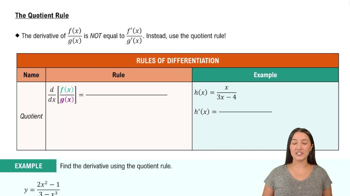
The Quotient Rule is a method for finding the derivative of a function that is the ratio of two differentiable functions. If you have a function f(x) = g(x)/h(x), the derivative f'(x) is given by (g'(x)h(x) - g(x)h'(x)) / (h(x))^2. This rule is essential for differentiating functions expressed as fractions, such as x⁻ᵐ, which can be rewritten as 1/xᵐ.
Recommended video:
The Quotient Rule
Power Rule for Derivatives
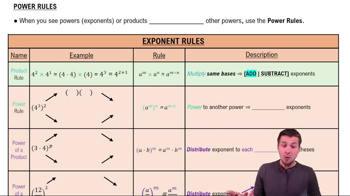
The Power Rule is a basic rule in calculus for finding the derivative of a function of the form f(x) = xⁿ, where n is any real number. The derivative is given by f'(x) = nxⁿ⁻¹. This rule simplifies the process of differentiation and is fundamental for understanding how to handle powers of x, including negative powers.
Recommended video:
Power Rules
Negative Integer Exponents
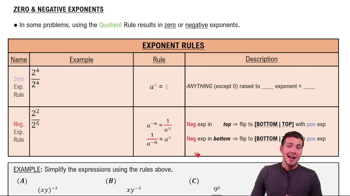
Negative integer exponents indicate the reciprocal of the base raised to the corresponding positive exponent. For example, x⁻ᵐ is equivalent to 1/xᵐ. Understanding this concept is crucial when applying the Power Rule to negative exponents, as it involves rewriting the expression in a form suitable for differentiation using the Quotient Rule.
Recommended video:
Zero and Negative Rules
Related Practice
Textbook Question
Textbook Question
In Exercises 83–88, find equations for the lines that are tangent, and the lines that are normal, to the curve at the given point.
__
x + √xy = 6, (4, 1)
Textbook Question
Derivatives in Differential Form
In Exercises 17–28, find dy.
y = (2√x)/(3(1 + √x))
Textbook Question
In Exercises 19–22, find the slope of the curve at the point indicated.
y = x³ − 2x + 7, x = −2
Textbook Question
[Technology Exercise]
Graph the curves in Exercises 39–48.
a. Where do the graphs appear to have vertical tangent lines?
b. Confirm your findings in part (a) with limit calculations. But before you do, read the introduction to Exercises 37 and 38.
y = 4x²/⁵ − 2x
Textbook Question
One-Sided Derivatives
Compute the right-hand and left-hand derivatives as limits to show that the functions in Exercises 37–40 are not differentiable at the point P.