Parallel tangent lines Find the two points where the curve x² + xy + y² = 7 crosses the x-axis, and show that the tangent lines to the curve at these points are parallel. What is the common slope of these tangent lines?

Ch. 3 - Derivatives
Chapter 3, Problem 3.9.22
Derivatives in Differential Form
In Exercises 17–28, find dy.
xy² − 4x³/² − y = 0
Verified step by step guidance1
First, identify the given equation: \( xy^2 - 4x^{3/2} - y = 0 \). This is an implicit function involving both x and y.
To find \( \frac{dy}{dx} \), we need to differentiate both sides of the equation with respect to x. Remember that y is a function of x, so use implicit differentiation.
Differentiate each term: For \( xy^2 \), use the product rule: \( \frac{d}{dx}(xy^2) = x \frac{d}{dx}(y^2) + y^2 \frac{d}{dx}(x) \). For \( y^2 \), use the chain rule: \( \frac{d}{dx}(y^2) = 2y \frac{dy}{dx} \).
Differentiate \( -4x^{3/2} \) using the power rule: \( \frac{d}{dx}(-4x^{3/2}) = -4 \cdot \frac{3}{2}x^{1/2} \).
Differentiate \( -y \) with respect to x: \( \frac{d}{dx}(-y) = -\frac{dy}{dx} \). Combine all differentiated terms and solve for \( \frac{dy}{dx} \).

Verified video answer for a similar problem:
This video solution was recommended by our tutors as helpful for the problem above.
Video duration:
5mWas this helpful?
Key Concepts
Here are the essential concepts you must grasp in order to answer the question correctly.
Implicit Differentiation
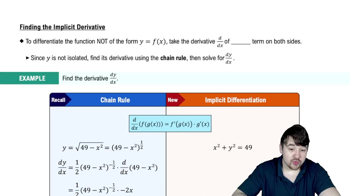
Implicit differentiation is a technique used to differentiate equations where the dependent and independent variables are not explicitly separated. In this method, we differentiate both sides of the equation with respect to the independent variable, applying the chain rule when necessary. This allows us to find the derivative of one variable in terms of the other, even when they are intertwined.
Recommended video:
Finding The Implicit Derivative
Chain Rule
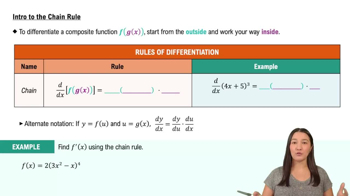
The chain rule is a fundamental principle in calculus that allows us to differentiate composite functions. It states that if a function y is composed of another function u, then the derivative of y with respect to x can be found by multiplying the derivative of y with respect to u by the derivative of u with respect to x. This is crucial when dealing with implicit functions where one variable depends on another.
Recommended video:
Intro to the Chain Rule
Differential Notation
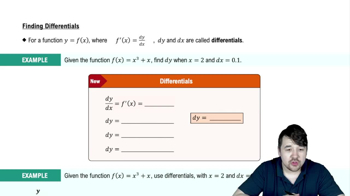
Differential notation involves expressing derivatives in terms of differentials, such as dy and dx. In the context of implicit differentiation, dy represents the change in the dependent variable y, while dx represents the change in the independent variable x. Understanding this notation is essential for solving equations involving derivatives, as it helps clarify the relationship between the variables and their rates of change.
Recommended video:
Finding Differentials
Related Practice
Textbook Question
Textbook Question
Finding Derivative Functions and Values
Using the definition, calculate the derivatives of the functions in Exercises 1–6. Then find the values of the derivatives as specified.
f(x) = 4 – x²; f′(−3), f′(0), f′(1)
1
views
Textbook Question
Derivatives in Differential Form
In Exercises 17–28, find dy.
y = (2√x)/(3(1 + √x))
Textbook Question
In Exercises 19–22, find the slope of the curve at the point indicated.
y = x³ − 2x + 7, x = −2
Textbook Question
The edge x of a cube is measured with an error of at most 0.5%. What is the maximum corresponding percentage error in computing the cube’s
b. volume?