Ch. 3 - Derivatives
Hass - Thomas' Calculus 15th Edition
Hass15th EditionThomas' CalculusISBN: 9780137616077Not the one you use?Change textbook
Chapter 3, Problem 112a

How accurately should you measure the edge of a cube to be reasonably sure of calculating the cube’s surface area with an error of no more than 2%?

Verified step by step guidance
1
First, understand the formula for the surface area of a cube. The surface area \( S \) of a cube with edge length \( x \) is given by \( S = 6x^2 \).
Next, consider the concept of error propagation. We want the error in the surface area \( \Delta S \) to be no more than 2% of the actual surface area \( S \). This means \( \Delta S \leq 0.02S \).
To find \( \Delta S \), use the derivative of the surface area with respect to \( x \). The derivative \( \frac{dS}{dx} = 12x \) gives the rate of change of the surface area with respect to changes in \( x \).
The error in \( x \), denoted as \( \Delta x \), affects \( S \) through \( \Delta S \approx \frac{dS}{dx} \cdot \Delta x = 12x \cdot \Delta x \). Set this expression less than or equal to 2% of \( S \), i.e., \( 12x \cdot \Delta x \leq 0.02 \cdot 6x^2 \).
Solve the inequality \( 12x \cdot \Delta x \leq 0.12x^2 \) to find \( \Delta x \leq 0.01x \). This means the edge length \( x \) should be measured with an accuracy of at least 1% to ensure the surface area error is within 2%.

Verified video answer for a similar problem:

This video solution was recommended by our tutors as helpful for the problem above.
Video duration:
3m
Was this helpful?

Key Concepts

Here are the essential concepts you must grasp in order to answer the question correctly.

Surface Area of a Cube

The surface area of a cube is calculated using the formula A = 6s², where 's' is the length of one edge of the cube. Understanding this formula is essential because it directly relates the edge measurement to the total surface area, allowing us to assess how changes in 's' affect the calculated area.
Recommended video:
09:07
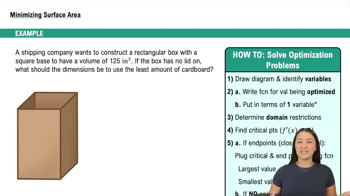
Example 1: Minimizing Surface Area

Percentage Error

Percentage error is a way to express the accuracy of a measurement relative to the true value. It is calculated as (|measured value - true value| / true value) × 100%. In this context, we need to ensure that the error in measuring the edge of the cube leads to a surface area calculation error of no more than 2%, which requires careful consideration of how measurement inaccuracies propagate.
Recommended video:
04:57
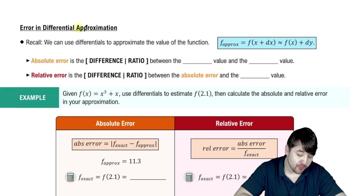
Determining Error and Relative Error

Differentiation and Error Propagation

Differentiation is a fundamental concept in calculus that helps us understand how a small change in one variable affects another variable. In this case, we can use differentiation to analyze how a small error in measuring the edge length 's' influences the surface area. This relationship is crucial for determining the maximum allowable error in the edge measurement to keep the surface area error within the specified 2% limit.
Recommended video:
04:57
Determining Error and Relative Error