Ch. 3 - Derivatives
Hass - Thomas' Calculus 15th Edition
Hass15th EditionThomas' CalculusISBN: 9780137616077Not the one you use?Change textbook
Chapter 3, Problem 113

The circumference of the equator of a sphere is measured as 10 cm with a possible error of 0.4 cm. This measurement is used to calculate the radius. The radius is then used to calculate the surface area and volume of the sphere. Estimate the percentage errors in the calculated values of


a. the radius.
b. the surface area.
c. the volume.

Verified step by step guidance
1
To find the radius of the sphere, use the formula for the circumference of a circle: \( C = 2\pi r \). Solve for \( r \) to get \( r = \frac{C}{2\pi} \). Substitute the given circumference (10 cm) to find the radius.
Calculate the error in the radius using the formula for error propagation: \( \Delta r = \frac{\Delta C}{2\pi} \), where \( \Delta C = 0.4 \) cm is the error in the circumference.
Estimate the percentage error in the radius by dividing the error in the radius by the calculated radius and multiplying by 100: \( \text{Percentage error in } r = \left( \frac{\Delta r}{r} \right) \times 100 \).
For the surface area \( A \) of the sphere, use the formula \( A = 4\pi r^2 \). The error in the surface area can be estimated using \( \Delta A = 8\pi r \Delta r \). Calculate the percentage error in the surface area: \( \text{Percentage error in } A = \left( \frac{\Delta A}{A} \right) \times 100 \).
For the volume \( V \) of the sphere, use the formula \( V = \frac{4}{3}\pi r^3 \). The error in the volume can be estimated using \( \Delta V = 4\pi r^2 \Delta r \). Calculate the percentage error in the volume: \( \text{Percentage error in } V = \left( \frac{\Delta V}{V} \right) \times 100 \).

Verified video answer for a similar problem:

This video solution was recommended by our tutors as helpful for the problem above.
Video duration:
5m
Was this helpful?

Key Concepts

Here are the essential concepts you must grasp in order to answer the question correctly.

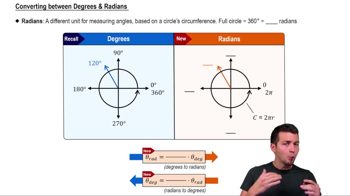
Circumference and Radius Relationship

The circumference of a sphere is directly related to its radius through the formula C = 2πr, where C is the circumference and r is the radius. Understanding this relationship is crucial for calculating the radius from the given circumference measurement. Any error in the circumference will propagate to the radius calculation, affecting subsequent calculations.
Recommended video:
Guided course
5:04
Converting between Degrees & Radians

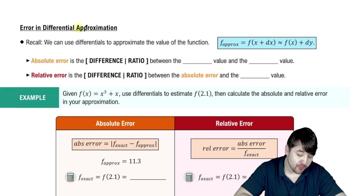
Propagation of Errors

Propagation of errors refers to how uncertainties in measurements affect the final results of calculations. When calculating derived quantities like surface area and volume from the radius, the percentage error in the radius will influence the percentage errors in these derived quantities. This concept is essential for estimating how measurement inaccuracies impact overall results.
Recommended video:
04:57
Determining Error and Relative Error

Surface Area and Volume Formulas

The surface area and volume of a sphere are calculated using the formulas A = 4πr² for surface area and V = (4/3)πr³ for volume. Understanding these formulas is necessary to compute the surface area and volume based on the radius. The relationship between the radius and these derived quantities highlights how changes in the radius affect the overall measurements.
Recommended video:
09:07
Example 1: Minimizing Surface Area