
Ch. 3 - Derivatives
Hass - Thomas' Calculus 15th Edition
Hass15th EditionThomas' CalculusISBN: 9780137616077Not the one you use?Change textbook
Chapter 3, Problem 105b

Moving searchlight beam The figure shows a boat 1 km offshore, sweeping the shore with a searchlight. The light turns at a constant rate, /dt = -0.6 rad/sec.


b. How many revolutions per minute is 0.6 rad/sec?


<IMAGE>

Verified step by step guidance
1
Understand the problem: We need to convert the angular speed from radians per second to revolutions per minute.
Recall the relationship between radians and revolutions: One complete revolution is equivalent to 2π radians.
Calculate the number of revolutions per second: Divide the angular speed by 2π to convert from radians per second to revolutions per second. Use the formula: \( \text{revolutions per second} = \frac{d\theta/dt}{2\pi} \).
Convert revolutions per second to revolutions per minute: Multiply the result from the previous step by 60, since there are 60 seconds in a minute.
Express the final result: The number of revolutions per minute is the product of the conversion factor and the angular speed in revolutions per second.

Verified video answer for a similar problem:

This video solution was recommended by our tutors as helpful for the problem above.
Video duration:
3m
Was this helpful?

Key Concepts

Here are the essential concepts you must grasp in order to answer the question correctly.

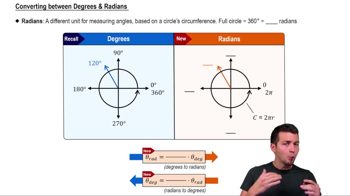
Radians and Revolutions

Radians are a unit of angular measure used in mathematics, where one full revolution (360 degrees) is equal to 2π radians. Understanding the relationship between radians and revolutions is crucial for converting angular velocity from radians per second to revolutions per minute.
Recommended video:
Guided course
5:04
Converting between Degrees & Radians

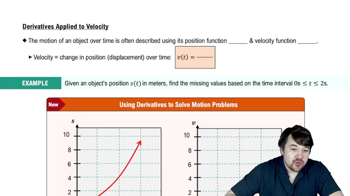
Angular Velocity

Angular velocity is a measure of how quickly an object rotates or moves around a central point, typically expressed in radians per second. In this context, the angular velocity of the searchlight beam is given as -0.6 rad/sec, indicating the rate at which the beam sweeps across the shore.
Recommended video:
06:29
Derivatives Applied To Velocity

Conversion of Units

Converting units is a fundamental skill in calculus and physics, allowing for the translation of measurements from one system to another. To find revolutions per minute from radians per second, one must apply conversion factors, specifically recognizing that 1 revolution equals 2π radians and there are 60 seconds in a minute.
Recommended video:
5:10
Evaluate Composite Functions - Values on Unit Circle