
Ch. 3 - Derivatives
Hass - Thomas' Calculus 15th Edition
Hass15th EditionThomas' CalculusISBN: 9780137616077Not the one you use?Change textbook
Chapter 3, Problem 3.8.18a

Diagonals If x, y, and z are lengths of the edges of a rectangular box, then the common length of the box’s diagonals is s = √(x² + y² + z²).
a. Assuming that x, y, and z are differentiable functions of t, how is ds/dt related to dx/dt, dy/dt, and dz/dt?

Verified step by step guidance
1
Start by recognizing that the given formula for the diagonal length s is s = √(x² + y² + z²). This is a function of x, y, and z, which are themselves functions of t.
To find ds/dt, apply the chain rule for differentiation. The chain rule states that if a variable depends on multiple other variables, each of which depends on another variable, you differentiate with respect to each intermediate variable and multiply by the derivative of the intermediate variable with respect to the final variable.
Differentiate s with respect to t: ds/dt = (1/2)(x² + y² + z²)^(-1/2) * (2x dx/dt + 2y dy/dt + 2z dz/dt). This uses the chain rule and the power rule for differentiation.
Simplify the expression: ds/dt = (x dx/dt + y dy/dt + z dz/dt) / √(x² + y² + z²). This is the relationship between ds/dt and the rates of change of x, y, and z with respect to t.
This result shows how the rate of change of the diagonal length s is a weighted sum of the rates of change of the box's edge lengths, where each weight is the corresponding edge length divided by the diagonal length.

Verified video answer for a similar problem:

This video solution was recommended by our tutors as helpful for the problem above.
Video duration:
3m
Was this helpful?

Key Concepts

Here are the essential concepts you must grasp in order to answer the question correctly.

Differentiation

Differentiation is a fundamental concept in calculus that deals with finding the rate at which a function changes at any given point. It involves computing the derivative, which represents the slope of the tangent line to the function's graph. In this context, it helps determine how the diagonal length changes with respect to time.
Recommended video:
05:53
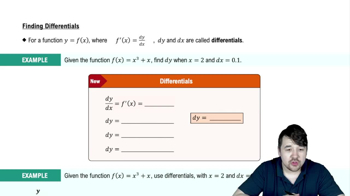
Finding Differentials

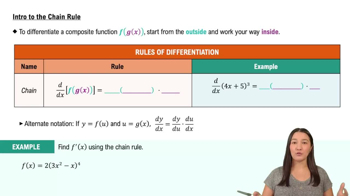
Chain Rule

The chain rule is a formula for computing the derivative of a composite function. It states that the derivative of a function with respect to a variable can be found by multiplying the derivative of the function with respect to an intermediate variable by the derivative of the intermediate variable with respect to the original variable. This rule is essential for relating ds/dt to dx/dt, dy/dt, and dz/dt.
Recommended video:
05:02
Intro to the Chain Rule

Partial Derivatives

Partial derivatives involve taking the derivative of a multivariable function with respect to one variable while keeping the other variables constant. In the context of the diagonal length formula, partial derivatives help in understanding how changes in each edge length (x, y, z) individually affect the diagonal length, which is crucial for applying the chain rule.
Recommended video:
05:44
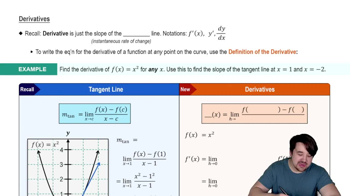
Derivatives