
Ch. 3 - Derivatives
Hass - Thomas' Calculus 15th Edition
Hass15th EditionThomas' CalculusISBN: 9780137616077Not the one you use?Change textbook
Chapter 3, Problem 3.4.4a

Motion Along a Coordinate Line


Exercises 1–6 give the positions s = f(t) of a body moving on a coordinate line, with s in meters and t in seconds.


a. Find the body’s displacement and average velocity for the given time interval.


s = (t⁴/4) − t³ + t², 0 ≤ t ≤ 3

Verified step by step guidance
1
To find the body's displacement over the interval [0, 3], calculate the difference in position at the endpoints of the interval. Evaluate the position function s(t) at t = 3 and t = 0, then subtract: Displacement = s(3) - s(0).
Evaluate s(3) by substituting t = 3 into the position function: s(3) = (3^4/4) - 3^3 + 3^2.
Evaluate s(0) by substituting t = 0 into the position function: s(0) = (0^4/4) - 0^3 + 0^2.
Calculate the displacement using the results from the previous steps: Displacement = s(3) - s(0).
To find the average velocity over the interval [0, 3], use the formula: Average Velocity = Displacement / (3 - 0). Substitute the displacement found in the previous step and simplify.

Verified video answer for a similar problem:

This video solution was recommended by our tutors as helpful for the problem above.
Video duration:
2m
Was this helpful?

Key Concepts

Here are the essential concepts you must grasp in order to answer the question correctly.

Displacement

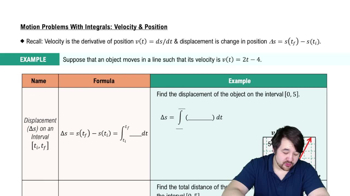
Displacement refers to the change in position of a body over a specific time interval. It is calculated by finding the difference between the final and initial positions, s(t_final) - s(t_initial). In this context, it helps determine how far the body has moved along the coordinate line from t = 0 to t = 3 seconds.
Recommended video:
10:17
Using The Velocity Function

Average Velocity

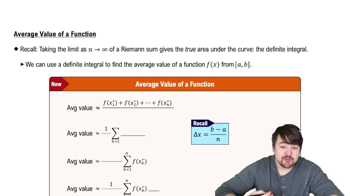
Average velocity is the total displacement divided by the total time taken. It provides a measure of how fast the body is moving on average over the given time interval. Mathematically, it is expressed as (s(t_final) - s(t_initial)) / (t_final - t_initial), offering insight into the body's overall speed and direction.
Recommended video:
06:37
Average Value of a Function

Position Function

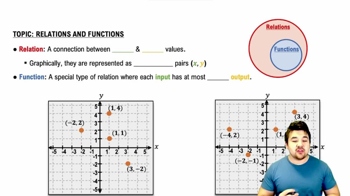
The position function, s = f(t), describes the location of a body at any given time t. In this problem, s = (t⁴/4) − t³ + t² represents the body's position in meters as a function of time in seconds. Understanding this function is crucial for calculating displacement and average velocity, as it provides the necessary values for s at different times.
Recommended video:
5:20
Relations and Functions