
Ch. 3 - Derivatives
Hass - Thomas' Calculus 15th Edition
Hass15th EditionThomas' CalculusISBN: 9780137616077Not the one you use?Change textbook
Chapter 3, Problem 3.8.19a

Area The area A of a triangle with sides of lengths a and b enclosing an angle of measure θ is
A = (1/2) ab sinθ.


a. How is dA/dt related to dθ/dt if a and b are constant?

Verified step by step guidance
1
Start by understanding the formula for the area of a triangle: A = (1/2)ab sin(θ). Here, a and b are constants, and θ is the variable that changes over time.
To find how dA/dt is related to dθ/dt, apply the chain rule of differentiation. Since a and b are constants, differentiate A with respect to θ: dA/dθ = (1/2)ab cos(θ).
Now, use the chain rule to relate dA/dt to dθ/dt. The chain rule states that dA/dt = (dA/dθ) * (dθ/dt).
Substitute the expression for dA/dθ from step 2 into the chain rule formula: dA/dt = (1/2)ab cos(θ) * dθ/dt.
This equation shows that the rate of change of the area with respect to time, dA/dt, is directly proportional to the rate of change of the angle with respect to time, dθ/dt, and depends on the cosine of the angle θ.

Verified video answer for a similar problem:

This video solution was recommended by our tutors as helpful for the problem above.
Video duration:
2m
Was this helpful?

Key Concepts

Here are the essential concepts you must grasp in order to answer the question correctly.

Derivative

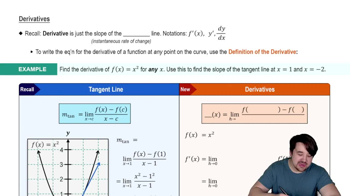
The derivative represents the rate of change of a function with respect to a variable. In this context, dA/dt is the derivative of the area A with respect to time t, indicating how the area changes as the angle θ changes over time.
Recommended video:
05:44
Derivatives

Chain Rule

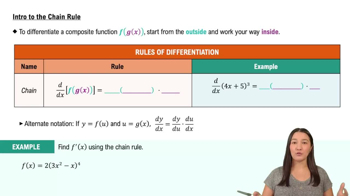
The chain rule is a fundamental theorem in calculus used to differentiate composite functions. It allows us to find the derivative of a function with respect to an intermediate variable, such as θ, when the function is expressed in terms of another variable, like t. Here, it helps relate dA/dt to dθ/dt.
Recommended video:
05:02
Intro to the Chain Rule

Trigonometric Functions

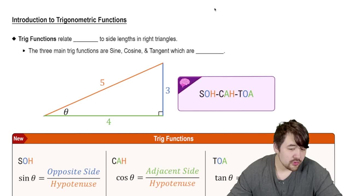
Trigonometric functions, such as sine, are essential in relating angles to side lengths in triangles. The function sinθ is used in the formula for the area of a triangle, and understanding its derivative is crucial for determining how changes in θ affect the area A when differentiating A = (1/2) ab sinθ.
Recommended video:
6:04
Introduction to Trigonometric Functions