Ch. 3 - Derivatives
Hass - Thomas' Calculus 15th Edition
Hass15th EditionThomas' CalculusISBN: 9780137616077Not the one you use?Change textbook
Chapter 3, Problem 3.8.32a

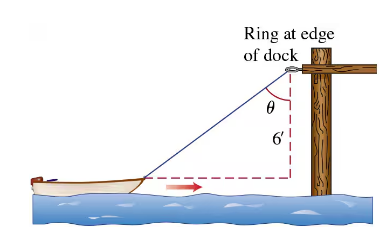
Hauling in a dinghy A dinghy is pulled toward a dock by a rope from the bow through a ring on the dock 6 ft above the bow. The rope is hauled in at the rate of 2 ft/sec.


a. How fast is the boat approaching the dock when 10 ft of rope are out?


Diagram showing a dinghy being pulled toward a dock by a rope through a ring 6 ft above the water.

Verified step by step guidance
1
Identify the right triangle formed by the rope, the vertical distance from the dock to the bow (6 ft), and the horizontal distance from the dock to the boat. Let x be the horizontal distance from the dock to the boat, and let L be the length of the rope.
Use the Pythagorean theorem to relate x, L, and the vertical distance: \( L^2 = x^2 + 6^2 \).
Differentiate both sides of the equation with respect to time t to find the relationship between the rates of change: \( 2L \frac{dL}{dt} = 2x \frac{dx}{dt} \).
Substitute the given values into the differentiated equation. You know \( \frac{dL}{dt} = -2 \) ft/sec (since the rope is being pulled in), L = 10 ft, and solve for \( \frac{dx}{dt} \), the rate at which the boat is approaching the dock.
Calculate x when L = 10 ft using the Pythagorean theorem: \( x = \sqrt{L^2 - 6^2} \). Substitute this value of x into the differentiated equation to find \( \frac{dx}{dt} \).

Verified video answer for a similar problem:

This video solution was recommended by our tutors as helpful for the problem above.
Video duration:
4m
Was this helpful?

Key Concepts

Here are the essential concepts you must grasp in order to answer the question correctly.

Related Rates

Related rates involve finding the rate at which one quantity changes with respect to another. In this problem, the rate at which the rope is hauled in affects the rate at which the dinghy approaches the dock. By using derivatives, we can relate these rates and solve for the unknown rate of the dinghy's movement.
Recommended video:
04:16
Intro To Related Rates

Pythagorean Theorem

The Pythagorean Theorem is essential for relating the lengths in this problem. The rope forms the hypotenuse of a right triangle, with the vertical distance from the dock to the water and the horizontal distance from the dock to the dinghy as the other sides. This relationship helps in setting up the equation needed to find the rate at which the dinghy approaches the dock.
Recommended video:
06:11
Fundamental Theorem of Calculus Part 1

Differentiation

Differentiation is used to find the rate of change of a function. In this context, it helps determine how the length of the rope and the position of the dinghy change over time. By differentiating the equation derived from the Pythagorean Theorem, we can find the rate at which the dinghy approaches the dock when a specific length of rope is out.
Recommended video:
05:53
Finding Differentials