Ch. 3 - Derivatives
Hass - Thomas' Calculus 15th Edition
Hass15th EditionThomas' CalculusISBN: 9780137616077Not the one you use?Change textbook
Chapter 3, Problem 3.5.53b

By computing the first few derivatives and looking for a pattern, find the following derivatives.


b. d¹¹⁰/dx¹¹⁰ (sin x − 3 cos x)

Verified step by step guidance
1
First, identify the function for which we need to find the 110th derivative: f(x) = sin(x) - 3cos(x).
Compute the first derivative: f'(x) = cos(x) + 3sin(x).
Compute the second derivative: f''(x) = -sin(x) + 3cos(x).
Compute the third derivative: f'''(x) = -cos(x) - 3sin(x).
Observe the pattern in the derivatives: The derivatives repeat every four steps. Use this pattern to determine the 110th derivative by finding the remainder of 110 divided by 4.

Verified video answer for a similar problem:

This video solution was recommended by our tutors as helpful for the problem above.
Video duration:
3m
Was this helpful?

Key Concepts

Here are the essential concepts you must grasp in order to answer the question correctly.

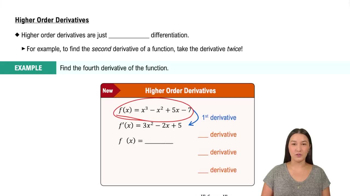
Higher Order Derivatives

Higher order derivatives refer to the derivatives of a function taken multiple times. For example, the second derivative is the derivative of the first derivative. In this problem, you need to compute the 110th derivative, which involves identifying a pattern in the derivatives of the given function.
Recommended video:
02:42
Higher Order Derivatives

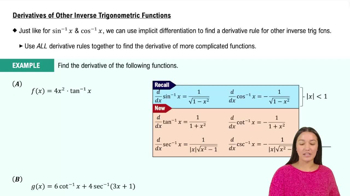
Trigonometric Derivatives

Understanding the derivatives of trigonometric functions is crucial. The derivative of sin(x) is cos(x), and the derivative of cos(x) is -sin(x). These derivatives repeat in a cycle, which is key to identifying patterns when computing higher order derivatives of trigonometric expressions.
Recommended video:
06:35
Derivatives of Other Inverse Trigonometric Functions

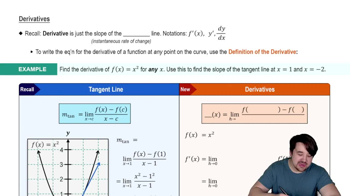
Pattern Recognition in Derivatives

When computing higher order derivatives, recognizing patterns can simplify the process. For trigonometric functions, derivatives often repeat in cycles. By calculating the first few derivatives, you can identify the cycle length and predict the 110th derivative without computing each one individually.
Recommended video:
05:44
Derivatives
Related Practice
Textbook Question

b. Slopes on a tangent curve What is the smallest value the slope of the curve can ever have on the interval −2 < x < 2? Give reasons for your answer.

Textbook Question

Average single-family home prices P (in thousands of dollars) in Sacramento, California, are shown in the accompanying figure from the beginning of 2006 through the end of 2015.


b. Estimate home prices at the end of

i) 2007 ii) 2012 iii) 2015

2
views
Textbook Question

Motion Along a Coordinate Line


Exercises 1–6 give the positions s = f(t) of a body moving on a coordinate line, with s in meters and t in seconds.


b. Find the body’s speed and acceleration at the endpoints of the interval.


s = 25/t² − 5/t, 1 ≤ t ≤ 5

Textbook Question

A sliding ladder


A 13-ft ladder is leaning against a house when its base starts to slide away. By the time the base is 12 ft from the house, the base is moving at the rate of 5 ft/sec.


b. At what rate is the area of the triangle formed by the ladder, wall, and ground changing then?


Textbook Question

Fruit flies (Continuation of Example 4, Section 2.1.) Populations starting out in closed environments grow slowly at first, when there are relatively few members, then more rapidly as the number of reproducing individuals increases and resources are still abundant, then slowly again as the population reaches the carrying capacity of the environment.


b. During what days does the population seem to be increasing fastest? Slowest?


Textbook Question

Temperature The given graph shows the outside temperature T in °F, between 6 a.m. and 6 p.m.

b. At what time does the temperature increase most rapidly? Decrease most rapidly? What is the rate for each of those times?