

Ch. 3 - Derivatives
Hass - Thomas' Calculus 15th Edition
Hass15th EditionThomas' CalculusISBN: 9780137616077Not the one you use?Change textbook
Chapter 3, Problem 3.8.23b

A sliding ladder


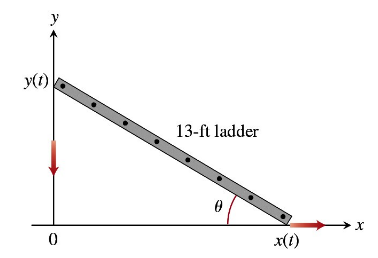
A 13-ft ladder is leaning against a house when its base starts to slide away. By the time the base is 12 ft from the house, the base is moving at the rate of 5 ft/sec.


b. At what rate is the area of the triangle formed by the ladder, wall, and ground changing then?


A diagram showing a 13-ft ladder leaning against a wall, with labeled axes for height and distance from the wall.

Verified step by step guidance
1
First, identify the triangle formed by the ladder, the wall, and the ground. The ladder acts as the hypotenuse, the distance from the wall to the base of the ladder is one leg, and the height from the ground to the top of the ladder is the other leg.
Use the Pythagorean theorem to relate the sides of the triangle: \( x^2 + y^2 = 13^2 \), where \( x \) is the distance from the wall to the base of the ladder, and \( y \) is the height of the ladder on the wall.
Differentiate the Pythagorean equation with respect to time \( t \) to find the relationship between the rates of change: \( 2x \frac{dx}{dt} + 2y \frac{dy}{dt} = 0 \). Given \( \frac{dx}{dt} = 5 \) ft/sec and \( x = 12 \) ft, solve for \( \frac{dy}{dt} \).
The area \( A \) of the triangle is given by \( A = \frac{1}{2}xy \). Differentiate this area formula with respect to time \( t \) to find \( \frac{dA}{dt} \): \( \frac{dA}{dt} = \frac{1}{2}(x \frac{dy}{dt} + y \frac{dx}{dt}) \).
Substitute the known values \( x = 12 \) ft, \( \frac{dx}{dt} = 5 \) ft/sec, and the calculated \( \frac{dy}{dt} \) into the differentiated area formula to find the rate at which the area of the triangle is changing.

Verified video answer for a similar problem:

This video solution was recommended by our tutors as helpful for the problem above.
Video duration:
6m
Was this helpful?

Key Concepts

Here are the essential concepts you must grasp in order to answer the question correctly.

Related Rates

Related rates are a method in calculus used to find the rate at which one quantity changes in relation to another. In this problem, we need to determine how the area of the triangle formed by the ladder, wall, and ground changes as the base of the ladder slides away from the wall. This involves differentiating the area with respect to time, using the known rates of change.
Recommended video:
04:16
Intro To Related Rates

Area of a Triangle

The area of a triangle can be calculated using the formula A = 1/2 * base * height. In this scenario, the base is the distance from the wall (x) and the height is the vertical distance from the ground to the top of the ladder (y). As the ladder slides, both x and y change, affecting the area, which we need to express in terms of these variables.
Recommended video:
05:06
Finding Area When Bounds Are Not Given

Pythagorean Theorem

The Pythagorean theorem states that in a right triangle, the square of the length of the hypotenuse (c) is equal to the sum of the squares of the lengths of the other two sides (a and b). In this case, the ladder acts as the hypotenuse, and we can use the theorem (x^2 + y^2 = 13^2) to relate the height and base of the triangle, which is essential for finding the rate of change of the area.
Recommended video:
06:11
Fundamental Theorem of Calculus Part 1
Related Practice
Textbook Question

Motion Along a Coordinate Line


Exercises 1–6 give the positions s = f(t) of a body moving on a coordinate line, with s in meters and t in seconds.


b. Find the body’s speed and acceleration at the endpoints of the interval.


s = 25/t² − 5/t, 1 ≤ t ≤ 5

Textbook Question

Quadratic approximations


b. Find the quadratic approximation to f(x) = 1/(1 − x) at x = 0.

Textbook Question

Suppose that the functions f and g and their derivatives with respect to x have the following values at x = 0 and x = 1.


" style="" width="250">


Find the derivatives with respect to x of the following combinations at the given value of x.


b. f(x)g³(x), x = 0

Textbook Question

Fruit flies (Continuation of Example 4, Section 2.1.) Populations starting out in closed environments grow slowly at first, when there are relatively few members, then more rapidly as the number of reproducing individuals increases and resources are still abundant, then slowly again as the population reaches the carrying capacity of the environment.


b. During what days does the population seem to be increasing fastest? Slowest?


Textbook Question

Hauling in a dinghy A dinghy is pulled toward a dock by a rope from the bow through a ring on the dock 6 ft above the bow. The rope is hauled in at the rate of 2 ft/sec.


b. At what rate is the angle θ changing at this instant (see the figure)?

Textbook Question

By computing the first few derivatives and looking for a pattern, find the following derivatives.


b. d¹¹⁰/dx¹¹⁰ (sin x − 3 cos x)