
Ch. 2 - Limits and Continuity
Hass - Thomas' Calculus 15th Edition
Hass15th EditionThomas' CalculusISBN: 9780137616077Not the one you use?Change textbook
Chapter 2, Problem 2.5.66

The sign-preserving property of continuous functions Let f be defined on an interval (a, b) and suppose that f(c) ≠ 0 at some c where f is continuous. Show that there is an interval (c − δ, c + δ) about c where f has the same sign as f(c).

Verified step by step guidance
1
Consider the definition of continuity: A function f is continuous at a point c if for every ε > 0, there exists a δ > 0 such that for all x in the interval (c - δ, c + δ), |f(x) - f(c)| < ε.
Since f(c) ≠ 0, we can choose ε = |f(c)|/2. This choice of ε ensures that f(x) is not zero in the interval (c - δ, c + δ).
By the continuity of f at c, there exists a δ > 0 such that for all x in (c - δ, c + δ), |f(x) - f(c)| < |f(c)|/2.
This inequality implies that f(x) is closer to f(c) than it is to zero, meaning f(x) and f(c) have the same sign. Specifically, if f(c) > 0, then f(x) > 0, and if f(c) < 0, then f(x) < 0.
Thus, there exists an interval (c - δ, c + δ) where f(x) maintains the same sign as f(c), demonstrating the sign-preserving property of continuous functions.

Verified video answer for a similar problem:

This video solution was recommended by our tutors as helpful for the problem above.
Video duration:
3m
Was this helpful?

Key Concepts

Here are the essential concepts you must grasp in order to answer the question correctly.

Continuous Functions

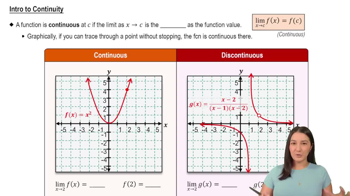
A function is continuous at a point if the limit of the function as it approaches that point equals the function's value at that point. This means there are no breaks, jumps, or holes in the function at that point. For continuous functions, small changes in the input result in small changes in the output, which is crucial for understanding the behavior of the function around a specific point.
Recommended video:
05:34
Intro to Continuity

Sign of a Function

The sign of a function at a point refers to whether the function's value is positive, negative, or zero. In this context, if f(c) is positive, we expect f to remain positive in a neighborhood around c, and similarly for negative values. Understanding the sign of a function helps in analyzing its behavior and determining intervals where the function maintains a consistent sign.
Recommended video:
4:46
Adding & Subtracting Functions Example 1

Delta-Epsilon Definition of Continuity

The delta-epsilon definition formalizes the concept of continuity by stating that for every ε > 0, there exists a δ > 0 such that if |x - c| < δ, then |f(x) - f(c)| < ε. This means that we can make the function values as close to f(c) as desired by choosing x sufficiently close to c. This concept is essential for proving that a function retains its sign in a neighborhood around a point where it is continuous.
Recommended video:
05:43
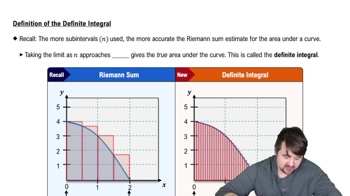
Definition of the Definite Integral