Ch. 2 - Limits and Continuity
Hass - Thomas' Calculus 15th Edition
Hass15th EditionThomas' CalculusISBN: 9780137616077Not the one you use?Change textbook
Chapter 2, Problem 2.5.63

Never-zero continuous functions Is it true that a continuous function that is never zero on an interval never changes sign on that interval? Give reasons for your answer.

Verified step by step guidance
1
Understand the problem: We are tasked with determining whether a continuous function that is never zero on an interval can change its sign on that interval. This involves analyzing the properties of continuous functions and their behavior with respect to sign changes.
Recall the Intermediate Value Theorem (IVT): The IVT states that if a function is continuous on a closed interval \([a, b]\), and takes on two values \(f(a)\) and \(f(b)\), then it must take on every value between \(f(a)\) and \(f(b)\) at some point in the interval. This theorem is key to understanding the behavior of continuous functions.
Analyze the implications of the function being 'never zero': If a function is never zero on an interval, it means that \(f(x) \neq 0\) for all \(x\) in the interval. This implies that the function does not cross the x-axis, as crossing the x-axis would require \(f(x) = 0\) at some point.
Consider the possibility of a sign change: For a function to change sign, it must transition from positive to negative or vice versa. However, if the function is continuous and never zero, the IVT implies that it cannot cross the x-axis, which is a necessary condition for a sign change.
Conclude the reasoning: Since the function is continuous and never zero, it cannot change sign on the interval. This is because a sign change would require the function to pass through zero, which contradicts the given condition that \(f(x) \neq 0\) for all \(x\) in the interval.

Verified video answer for a similar problem:

This video solution was recommended by our tutors as helpful for the problem above.
Video duration:
1m
Was this helpful?

Key Concepts

Here are the essential concepts you must grasp in order to answer the question correctly.

Continuous Functions

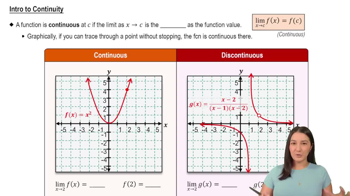
A continuous function is one where small changes in the input result in small changes in the output. Formally, a function f(x) is continuous at a point a if the limit of f(x) as x approaches a equals f(a). This property ensures that there are no abrupt jumps or breaks in the function's graph, which is crucial for understanding its behavior over an interval.
Recommended video:
05:34
Intro to Continuity

Sign of a Function

The sign of a function refers to whether its output values are positive, negative, or zero. A function is said to be positive on an interval if it takes only positive values and negative if it takes only negative values. Understanding the sign of a function is essential for analyzing its behavior, particularly in relation to its continuity and the implications of being never zero.
Recommended video:
4:46
Adding & Subtracting Functions Example 1

Intermediate Value Theorem

The Intermediate Value Theorem states that if a function is continuous on a closed interval [a, b] and takes on two values f(a) and f(b), then it must take on every value between f(a) and f(b) at least once. This theorem is significant in the context of the question because it implies that if a continuous function does not change sign (i.e., does not cross zero), it cannot take on both positive and negative values within that interval.
Recommended video:
06:11
Fundamental Theorem of Calculus Part 1