
Textbook Question
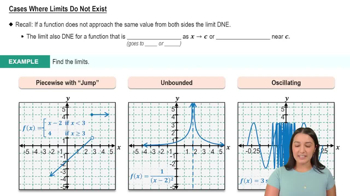
Define h(2) in a way that extends h(t) = (t² + 3t − 10)/(t − 2) to be continuous at t = 2.

 Verified step by step guidance
 03:07
03:07
 6:04
6:04 2:02
2:02Define h(2) in a way that extends h(t) = (t² + 3t − 10)/(t − 2) to be continuous at t = 2.
Using Limit Rules
Suppose lim x→0 f(x) = 1 and lim x→0 g(x) = −5. Name the rules in Theorem 1 that are used to accomplish steps (a), (b), and (c) of the following calculation.
limx→0 (2f(x) − g(x)) / (f(x) + 7)² = limx→0 (2f(x) − g(x)) / limx→0 (f(x) + 7)² (a)
(We assume the denominator is nonzero.)
(lim x→0 2f(x) − lim x→0 g(x)) / (lim x→0 (f(x) + 7))² (b)
= (2 lim x→0 f(x) − lim x→0 g(x)) / (lim x→0 f(x) + lim x→0 7)² (c)
= ((2)(1) − (−5)) / (1 + 7)² = 7/64
For what values of a and b is
g(x) = { ax + 2b, x ≤ 0
x² + 3a – b, 0 < x ≤ 2
3x – 5, x > 2
continuous at every x?
Using the Formal Definition
Prove the limit statements in Exercises 37–50.
limx→9 √(x − 5) = 2
Use formal definitions to prove the limit statements in Exercises 93–96.
lim x → 3 (−2 / (x − 3)²) = −∞
The sign-preserving property of continuous functions Let f be defined on an interval (a, b) and suppose that f(c) ≠ 0 at some c where f is continuous. Show that there is an interval (c − δ, c + δ) about c where f has the same sign as f(c).