Ch. 2 - Limits and Continuity
Hass - Thomas' Calculus 15th Edition
Hass15th EditionThomas' CalculusISBN: 9780137616077Not the one you use?Change textbook
Chapter 2, Problem 2.5.50

For what values of a and b is
g(x) = { ax + 2b, x ≤ 0
x² + 3a – b, 0 < x ≤ 2
3x – 5, x > 2
continuous at every x?

Verified step by step guidance
1
To ensure the function g(x) is continuous at every x, we need to check the continuity at the points where the piecewise function changes, specifically at x = 0 and x = 2.
For continuity at x = 0, the left-hand limit as x approaches 0 from the left (x ≤ 0) must equal the right-hand limit as x approaches 0 from the right (0 < x ≤ 2), and both must equal g(0). Set ax + 2b = x² + 3a - b at x = 0.
Substitute x = 0 into both expressions: ax + 2b becomes 2b, and x² + 3a - b becomes 3a - b. Set 2b = 3a - b to find a relationship between a and b.
For continuity at x = 2, the right-hand limit as x approaches 2 from the left (0 < x ≤ 2) must equal the left-hand limit as x approaches 2 from the right (x > 2), and both must equal g(2). Set x² + 3a - b = 3x - 5 at x = 2.
Substitute x = 2 into both expressions: x² + 3a - b becomes 4 + 3a - b, and 3x - 5 becomes 6 - 5. Set 4 + 3a - b = 1 to find another relationship between a and b. Solve the system of equations from steps 3 and 5 to find the values of a and b that make g(x) continuous at every x.

Verified video answer for a similar problem:

This video solution was recommended by our tutors as helpful for the problem above.
Video duration:
7m
Was this helpful?

Key Concepts

Here are the essential concepts you must grasp in order to answer the question correctly.

Continuity of Functions

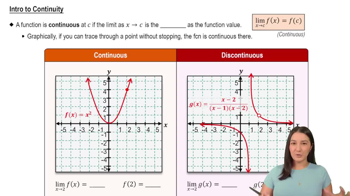
A function is continuous at a point if the limit of the function as it approaches that point from both sides equals the function's value at that point. For piecewise functions, this means ensuring that the function values match at the boundaries of the defined intervals.
Recommended video:
05:34
Intro to Continuity

Piecewise Functions

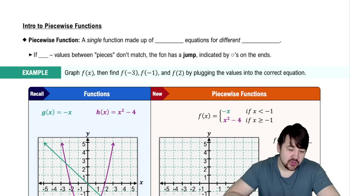
Piecewise functions are defined by different expressions based on the input value. In this case, g(x) has three different expressions depending on whether x is less than or equal to 0, between 0 and 2, or greater than 2. Analyzing continuity requires checking the transitions between these pieces.
Recommended video:
05:36
Piecewise Functions

Limit and Value Matching

To ensure continuity at the boundaries of the piecewise function, the limits from the left and right must equal the function's value at those points. This involves setting the expressions equal to each other at the transition points (x = 0 and x = 2) and solving for the parameters a and b.
Recommended video:
06:37
Average Value of a Function
Related Practice
Textbook Question

Finding Limits


In Exercises 3–8, find the limit of each function (a) as x → ∞ and (b) as x → −∞. (You may wish to visualize your answer with a graphing calculator or computer.)


h(x) = (−5 + (7/x))/(3 – (1/x²))

Textbook Question

Define h(2) in a way that extends h(t) = (t² + 3t − 10)/(t − 2) to be continuous at t = 2.

Textbook Question

Using Limit Rules


Suppose lim x→0 f(x) = 1 and lim x→0 g(x) = −5. Name the rules in Theorem 1 that are used to accomplish steps (a), (b), and (c) of the following calculation.


limx→0 (2f(x) − g(x)) / (f(x) + 7)² = limx→0 (2f(x) − g(x)) / limx→0 (f(x) + 7)² (a)


(We assume the denominator is nonzero.)


(lim x→0 2f(x) − lim x→0 g(x)) / (lim x→0 (f(x) + 7))² (b)


= (2 lim x→0 f(x) − lim x→0 g(x)) / (lim x→0 f(x) + lim x→0 7)² (c)


= ((2)(1) − (−5)) / (1 + 7)² = 7/64

Textbook Question

Limits as x → ∞ or x → −∞


The process by which we determine limits of rational functions applies equally well to ratios containing noninteger or negative powers of x. Divide numerator and denominator by the highest power of x in the denominator and proceed from there. Find the limits in Exercises 23–36. Write ∞ or −∞ where appropriate.


lim x → ⁻∞ ((1 − x³) / (x² + 7x))⁵

Textbook Question

Using the Formal Definition


Prove the limit statements in Exercises 37–50.


limx→9 √(x − 5) = 2

Textbook Question

Use formal definitions to prove the limit statements in Exercises 93–96.


lim x → 3 (−2 / (x − 3)²) = −∞