Ch. 11 - Parametric Equations and Polar Coordinates
Hass - Thomas' Calculus 15th Edition
Hass15th EditionThomas' CalculusISBN: 9780137616077Not the one you use?Change textbook
Chapter 11, Problem 11.3.3a

Polar Coordinates


Plot the following points, given in polar coordinates. Then find all the polar coordinates of each point.


a. (2, π/2)

Verified step by step guidance
1
Understand that a point in polar coordinates is given as \((r, \theta)\), where \(r\) is the distance from the origin and \(\theta\) is the angle measured from the positive x-axis.
For the point \((2, \frac{\pi}{2})\), plot it by moving 2 units from the origin in the direction of the angle \(\frac{\pi}{2}\) radians (which corresponds to 90 degrees, pointing straight up along the positive y-axis).
To find all polar coordinates for this point, recall that polar coordinates are not unique. You can add or subtract multiples of \(2\pi\) to the angle \(\theta\) without changing the point, so one set of coordinates is \((2, \frac{\pi}{2} + 2k\pi)\) for any integer \(k\).
Also, consider that if you take the negative radius \(-r\), you can add \(\pi\) to the angle to represent the same point. So another set of coordinates is \((-2, \frac{\pi}{2} + (2k+1)\pi)\) for any integer \(k\).
Summarize all possible coordinates as the union of these two sets: \((2, \frac{\pi}{2} + 2k\pi)\) and \((-2, \frac{\pi}{2} + (2k+1)\pi)\), where \(k\) is any integer.

Verified video answer for a similar problem:

This video solution was recommended by our tutors as helpful for the problem above.
Video duration:
4m
Was this helpful?

Key Concepts

Here are the essential concepts you must grasp in order to answer the question correctly.

Polar Coordinates System

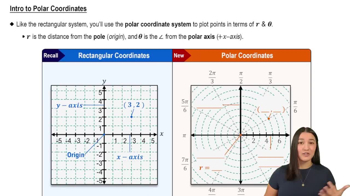
The polar coordinate system represents points in a plane using a radius and an angle. Each point is defined by (r, θ), where r is the distance from the origin and θ is the angle measured from the positive x-axis. This system is useful for describing locations in circular or rotational contexts.
Recommended video:
05:32
Intro to Polar Coordinates

Plotting Points in Polar Coordinates

To plot a point given in polar coordinates, start at the origin, rotate counterclockwise by the angle θ, then move outward along that direction by the distance r. For example, (2, π/2) means move 2 units upward since π/2 radians corresponds to 90 degrees.
Recommended video:
05:32
Intro to Polar Coordinates

Multiple Representations of Polar Coordinates

A single point in the plane can have multiple polar coordinate representations due to angle periodicity and sign of r. Adding 2π to the angle or using a negative radius with an adjusted angle gives equivalent coordinates, so all such forms must be considered when finding all polar coordinates of a point.
Recommended video:
05:32
Intro to Polar Coordinates