Ch. 11 - Parametric Equations and Polar Coordinates
Hass - Thomas' Calculus 15th Edition
Hass15th EditionThomas' CalculusISBN: 9780137616077Not the one you use?Change textbook
Chapter 11, Problem 11.1.29a

Finding Parametric Equations


Find parametric equations and a parameter interval for the motion of a particle that starts at (a, 0) and traces the circle x²+y²=a².


a. once clockwise.


(There are many ways to do these, so your answers may not be the same as the ones at the back of the text.)

Verified step by step guidance
1
Recall that the equation of the circle is given by \(x^{2} + y^{2} = a^{2}\). This describes a circle centered at the origin with radius \(a\).
To find parametric equations for the motion of a particle on this circle, use the standard parameterization involving trigonometric functions: \(x = a \cos(t)\) and \(y = a \sin(t)\), where \(t\) is the parameter.
Since the particle starts at the point \((a, 0)\), determine the value of \(t\) at the start. Substitute \(x = a\) and \(y = 0\) into the parametric equations to find the initial parameter value.
To trace the circle once clockwise, consider the direction of motion. The standard parameterization with \(t\) increasing from \(0\) to \(2\pi\) traces the circle counterclockwise. To reverse the direction, modify the parameterization to \(x = a \cos(t)\) and \(y = -a \sin(t)\).
Set the parameter interval for \(t\) to cover one full revolution, typically \(t\) going from \(0\) to \(2\pi\), to ensure the particle traces the entire circle once in the clockwise direction.

Verified video answer for a similar problem:

This video solution was recommended by our tutors as helpful for the problem above.
Video duration:
4m
Was this helpful?

Key Concepts

Here are the essential concepts you must grasp in order to answer the question correctly.

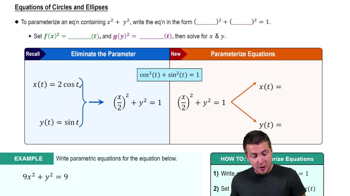
Parametric Equations of a Circle

Parametric equations express the coordinates of points on a curve as functions of a parameter, often time. For a circle of radius a centered at the origin, a common parametrization is x = a cos(t), y = a sin(t), where t varies over an interval to trace the circle.
Recommended video:
Guided course
06:03
Parameterizing Equations of Circles & Ellipses

Direction of Motion (Clockwise vs Counterclockwise)

The direction in which a particle moves along a curve depends on how the parameter affects the coordinates. For a circle, using x = a cos(t), y = a sin(t) traces counterclockwise motion, while x = a cos(t), y = -a sin(t) reverses the direction to clockwise.
Recommended video:
06:29
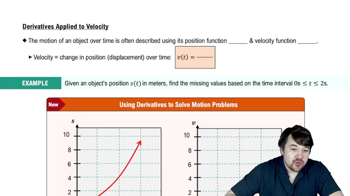
Derivatives Applied To Velocity

Parameter Interval and Initial Point

Choosing the correct parameter interval ensures the particle starts at the given point and completes the desired path. For starting at (a, 0), setting t = 0 at this point and letting t vary from 0 to 2π traces the full circle once.
Recommended video:
05:03
Initial Value Problems