Ch. 11 - Parametric Equations and Polar Coordinates
Hass - Thomas' Calculus 15th Edition
Hass15th EditionThomas' CalculusISBN: 9780137616077Not the one you use?Change textbook
Chapter 11, Problem 11.PE.33

Cartesian to Polar Equations


Find polar equations for the circles in Exercises 33–36. Sketch each circle in the coordinate plane and label it with both its Cartesian and polar equations.


x² + y² + 5y = 0

Verified step by step guidance
1
Start with the given Cartesian equation of the circle: \(x^{2} + y^{2} + 5y = 0\).
Rewrite the equation to complete the square for the \(y\) terms. Group \(y^{2} + 5y\) together: \(x^{2} + (y^{2} + 5y) = 0\).
Complete the square for \(y^{2} + 5y\) by adding and subtracting \(\left(\frac{5}{2}\right)^{2} = \frac{25}{4}\) inside the equation: \(x^{2} + \left(y^{2} + 5y + \frac{25}{4}\right) - \frac{25}{4} = 0\).
Rewrite the equation as \(x^{2} + \left(y + \frac{5}{2}\right)^{2} = \frac{25}{4}\), which represents a circle with center at \((0, -\frac{5}{2})\) and radius \(\frac{5}{2}\).
Convert to polar coordinates using \(x = r \cos{\theta}\) and \(y = r \sin{\theta}\). Substitute these into the equation: \(\left(r \cos{\theta}\right)^{2} + \left(r \sin{\theta} + \frac{5}{2}\right)^{2} = \frac{25}{4}\). This is the polar form of the circle's equation.

Verified video answer for a similar problem:

This video solution was recommended by our tutors as helpful for the problem above.
Video duration:
4m
Was this helpful?

Key Concepts

Here are the essential concepts you must grasp in order to answer the question correctly.

Conversion between Cartesian and Polar Coordinates

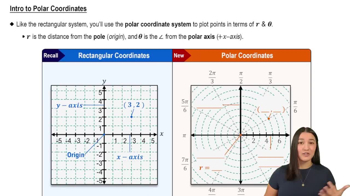
This concept involves expressing points from the Cartesian coordinate system (x, y) in terms of polar coordinates (r, θ), where x = r cos θ and y = r sin θ. Understanding this conversion is essential to rewrite Cartesian equations in polar form.
Recommended video:
05:32
Intro to Polar Coordinates

Equation of a Circle in Cartesian Coordinates

A circle in Cartesian form is typically expressed as (x - h)² + (y - k)² = r², where (h, k) is the center and r is the radius. Recognizing and rewriting the given equation into this standard form helps identify the circle’s center and radius.
Recommended video:
05:32
Intro to Polar Coordinates

Polar Form of a Circle Equation

After converting Cartesian coordinates to polar, the circle’s equation can be expressed in terms of r and θ. This often involves substituting x = r cos θ and y = r sin θ and simplifying to isolate r, which helps in sketching and understanding the circle in polar coordinates.
Recommended video:
6:50
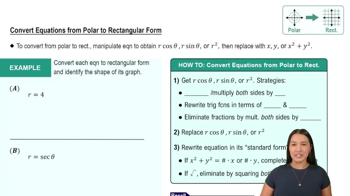
Convert Equations from Polar to Rectangular