Ch. 11 - Parametric Equations and Polar Coordinates
Hass - Thomas' Calculus 15th Edition
Hass15th EditionThomas' CalculusISBN: 9780137616077Not the one you use?Change textbook
Chapter 11, Problem 11.3.7b

Cartesian to Polar Coordinates


Find the polar coordinates, 0 ≤ θ < 2π and r ≥ 0, of the following points given in Cartesian coordinates.


b. (-3,0)

Verified step by step guidance
1
Recall the formulas to convert Cartesian coordinates \((x, y)\) to polar coordinates \((r, \theta)\): \(r = \sqrt{x^2 + y^2}\) and \(\theta = \arctan\left(\frac{y}{x}\right)\), with adjustments based on the quadrant of the point.
Substitute the given Cartesian coordinates \((-3, 0)\) into the formula for \(r\): \(r = \sqrt{(-3)^2 + 0^2} = \sqrt{9} = 3\).
Determine the angle \(\theta\) by considering the position of the point. Since \(y=0\) and \(x=-3\), the point lies on the negative x-axis.
Recall that on the negative x-axis, the angle \(\theta\) corresponds to \(\pi\) radians (180 degrees), which is within the range \(0 \leq \theta < 2\pi\).
Therefore, the polar coordinates are \((r, \theta) = (3, \pi)\), where \(r \geq 0\) and \(0 \leq \theta < 2\pi\).

Verified video answer for a similar problem:

This video solution was recommended by our tutors as helpful for the problem above.
Video duration:
1m
Was this helpful?

Key Concepts

Here are the essential concepts you must grasp in order to answer the question correctly.

Conversion between Cartesian and Polar Coordinates

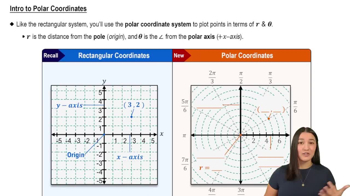
This concept involves translating a point from the Cartesian coordinate system (x, y) to the polar coordinate system (r, θ). The radius r is the distance from the origin to the point, calculated as r = √(x² + y²), and the angle θ is the counterclockwise angle from the positive x-axis to the point, found using θ = arctan(y/x), adjusted for the correct quadrant.
Recommended video:
05:32
Intro to Polar Coordinates

Determining the Radius r

The radius r represents the distance from the origin to the point in the plane. It is always non-negative and is computed using the Pythagorean theorem as r = √(x² + y²). For the point (-3, 0), r equals 3, indicating the point lies 3 units from the origin.
Recommended video:
07:36
Radius of Convergence

Finding the Angle θ in the Correct Range

The angle θ specifies the direction of the point from the positive x-axis, measured in radians between 0 and 2π. For points on the axes or in different quadrants, θ must be carefully determined to reflect the correct position. For (-3, 0), θ is π because the point lies on the negative x-axis.
Recommended video:
5:10
Finding the Domain and Range of a Graph