
Ch. 11 - Parametric Equations and Polar Coordinates
Hass - Thomas' Calculus 15th Edition
Hass15th EditionThomas' CalculusISBN: 9780137616077Not the one you use?Change textbook
Chapter 11, Problem 11.6.15

Parabolas


Exercises 9-16 give equations of parabolas. Find each parabola's focus and directrix. Then sketch the parabola. Include the focus and directrix in your sketch.


x = −3y²

Verified step by step guidance
1
Rewrite the given equation \(x = -3y^2\) in the standard form of a parabola that opens horizontally. The general form for a parabola opening left or right is \( (y - k)^2 = 4p(x - h) \), where \((h, k)\) is the vertex and \(p\) is the distance from the vertex to the focus (and also to the directrix).
Identify the vertex by comparing the given equation to the standard form. Since the equation is \(x = -3y^2\), it can be rewritten as \(y^2 = \frac{1}{-3} x\), or \( (y - 0)^2 = 4p(x - 0) \). This shows the vertex is at the origin \((0,0)\).
Determine the value of \$4p\( by matching coefficients. From \)y^2 = 4p x$, we see that \(4p = -\frac{1}{3}\), so \(p = -\frac{1}{12}\). The negative sign indicates the parabola opens to the left.
Find the focus using the vertex and \(p\). Since the parabola opens horizontally, the focus is at \((h + p, k)\), which is \((0 + p, 0) = \left(-\frac{1}{12}, 0\right)\).
Find the directrix, which is a vertical line located at \(x = h - p\). Using \(h=0\) and \(p = -\frac{1}{12}\), the directrix is at \(x = 0 - \left(-\frac{1}{12}\right) = \frac{1}{12}\). Then, sketch the parabola opening left with vertex at the origin, focus at \(\left(-\frac{1}{12}, 0\right)\), and directrix at \(x = \frac{1}{12}\).

Verified video answer for a similar problem:

This video solution was recommended by our tutors as helpful for the problem above.
Video duration:
2m
Was this helpful?

Key Concepts

Here are the essential concepts you must grasp in order to answer the question correctly.

Standard Form of a Parabola

A parabola can be expressed in standard form as either (x - h)² = 4p(y - k) or (y - k)² = 4p(x - h), where (h, k) is the vertex. This form helps identify the parabola's orientation and key features like the focus and directrix.
Recommended video:
3:40
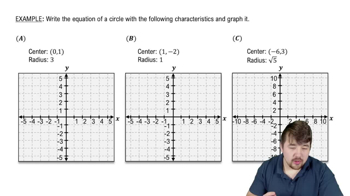
Circles in Standard Form Example 1

Focus and Directrix of a Parabola

The focus is a fixed point inside the parabola, and the directrix is a line outside it. The parabola consists of points equidistant from the focus and directrix. The parameter p determines the distance from the vertex to both the focus and directrix.
Recommended video:
5:28
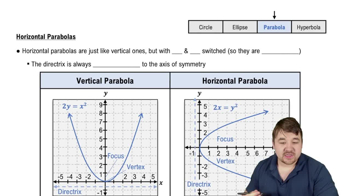
Horizontal Parabolas

Graphing Parabolas

To sketch a parabola, plot the vertex, focus, and directrix, then draw a smooth curve equidistant from the focus and directrix. Understanding the parabola's orientation (horizontal or vertical) guides the shape and direction of the graph.
Recommended video:
7:42
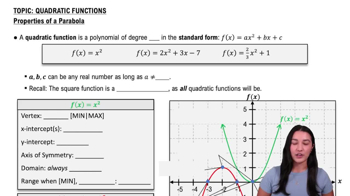
Properties of Parabolas
Related Practice
Textbook Question

Finding Cartesian from Parametric Equations


Exercises 1–18 give parametric equations and parameter intervals for the motion of a particle in the xy-plane. Identify the particle’s path by finding a Cartesian equation for it. Graph the Cartesian equation. (The graphs will vary with the equation used.) Indicate the portion of the graph traced by the particle and the direction of motion.


x = 2 sinh t, y = 2 cosh t, −∞<t<∞

Textbook Question

Circles


Sketch the circles in Exercises 53–56. Give polar coordinates for their centers and identify their radii.


r = −2 cos θ

1
views
Textbook Question

Ellipses


Exercises 25 and 26 give information about the foci and vertices of ellipses centered at the origin of the xy−plane. In each case, find the ellipse's standard−form equation from the given information.


Foci: ( ±√2, 0) Vertices: (±2,0)

Textbook Question

Parabolas


Exercises 9-16 give equations of parabolas. Find each parabola's focus and directrix. Then sketch the parabola. Include the focus and directrix in your sketch.


x² = 6y

Textbook Question

Shifting Conic Sections


You may wish to review Section 1.2 before solving Exercises 39-56.


Exercises 53-56 give equations for hyperbolas and tell how many units up or down and to the right or left each hyperbola is to be shifted. Find an equation for the new hyperbola, and find the new center, foci, vertices, and asymptotes.


x²/4 − y²/5 = 1, right 2, up 2

Textbook Question

Hyperbolas


Exercises 27-34 give equations for hyperbolas. Put each equation in standard form and find the hyperbola's asymptotes. Then sketch the hyperbola. Include the asymptotes and foci in your sketch.


8x² − 2y² = 16