
Ch. 11 - Parametric Equations and Polar Coordinates
Hass - Thomas' Calculus 15th Edition
Hass15th EditionThomas' CalculusISBN: 9780137616077Not the one you use?Change textbook
Chapter 11, Problem 11.1.18

Finding Cartesian from Parametric Equations


Exercises 1–18 give parametric equations and parameter intervals for the motion of a particle in the xy-plane. Identify the particle’s path by finding a Cartesian equation for it. Graph the Cartesian equation. (The graphs will vary with the equation used.) Indicate the portion of the graph traced by the particle and the direction of motion.


x = 2 sinh t, y = 2 cosh t, −∞<t<∞

Verified step by step guidance
1
Recall the definitions of hyperbolic sine and cosine: \(\sinh t = \frac{e^{t} - e^{-t}}{2}\) and \(\cosh t = \frac{e^{t} + e^{-t}}{2}\). These functions satisfy the identity \(\cosh^{2} t - \sinh^{2} t = 1\).
Given the parametric equations \(x = 2 \sinh t\) and \(y = 2 \cosh t\), express \(\sinh t\) and \(\cosh t\) in terms of \(x\) and \(y\): \(\sinh t = \frac{x}{2}\) and \(\cosh t = \frac{y}{2}\).
Use the hyperbolic identity \(\cosh^{2} t - \sinh^{2} t = 1\) and substitute the expressions for \(\sinh t\) and \(\cosh t\) to get \(\left(\frac{y}{2}\right)^{2} - \left(\frac{x}{2}\right)^{2} = 1\).
Simplify the equation to obtain the Cartesian form: \(\frac{y^{2}}{4} - \frac{x^{2}}{4} = 1\), which can be rewritten as \(\frac{y^{2}}{4} - \frac{x^{2}}{4} = 1\) or \(\frac{y^{2}}{4} - \frac{x^{2}}{4} = 1\).
Interpret the Cartesian equation as a hyperbola. The parameter \(t\) ranges over all real numbers, so the particle traces the entire hyperbola. The direction of motion corresponds to increasing \(t\), which can be analyzed by considering how \(x\) and \(y\) change as \(t\) increases.

Verified video answer for a similar problem:

This video solution was recommended by our tutors as helpful for the problem above.
Video duration:
11m
Was this helpful?

Key Concepts

Here are the essential concepts you must grasp in order to answer the question correctly.

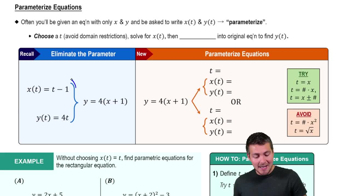
Parametric Equations

Parametric equations express the coordinates of points on a curve as functions of a parameter, often denoted t. Instead of y as a function of x, both x and y depend on t, allowing the description of more complex paths and motions in the plane.
Recommended video:
Guided course
08:02
Parameterizing Equations

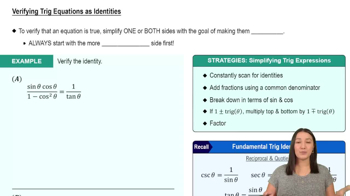
Hyperbolic Functions and Their Identities

Hyperbolic sine (sinh) and cosine (cosh) are analogs of trigonometric functions but relate to hyperbolas. They satisfy the identity cosh²(t) - sinh²(t) = 1, which is key to converting parametric equations involving sinh and cosh into a Cartesian equation.
Recommended video:
7:17
Verifying Trig Equations as Identities

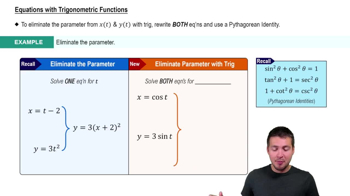
Eliminating the Parameter to Find Cartesian Equations

To find a Cartesian equation from parametric forms, the parameter t is eliminated by using algebraic manipulation and identities. This process yields a direct relationship between x and y, describing the particle’s path without reference to t.
Recommended video:
Guided course
04:11
Eliminate Parameter: Equations with Trig