Ch. 11 - Parametric Equations and Polar Coordinates
Hass - Thomas' Calculus 15th Edition
Hass15th EditionThomas' CalculusISBN: 9780137616077Not the one you use?Change textbook
Chapter 11, Problem 11.6.31

Hyperbolas


Exercises 27-34 give equations for hyperbolas. Put each equation in standard form and find the hyperbola's asymptotes. Then sketch the hyperbola. Include the asymptotes and foci in your sketch.


8x² − 2y² = 16

Verified step by step guidance
1
Start by rewriting the given equation \(8x^{2} - 2y^{2} = 16\) to isolate the terms and express it in the standard form of a hyperbola. Divide both sides of the equation by 16 to normalize the right side to 1, which is typical for conic sections.
After dividing, the equation becomes \(\frac{8x^{2}}{16} - \frac{2y^{2}}{16} = 1\). Simplify the fractions to get \(\frac{x^{2}}{2} - \frac{y^{2}}{8} = 1\). This is the standard form of a hyperbola centered at the origin with the transverse axis along the x-axis.
Identify the values of \(a^{2}\) and \(b^{2}\) from the standard form. Here, \(a^{2} = 2\) and \(b^{2} = 8\). These values will help in finding the asymptotes and foci.
Write the equations of the asymptotes for the hyperbola. Since the transverse axis is horizontal, the asymptotes are given by \(y = \pm \frac{b}{a} x\). Substitute \(a = \sqrt{2}\) and \(b = \sqrt{8}\) to express the asymptotes explicitly.
To find the foci, calculate \(c\) using the relationship \(c^{2} = a^{2} + b^{2}\). Then, the foci are located at \((\pm c, 0)\) because the transverse axis is along the x-axis. Use these points along with the asymptotes to sketch the hyperbola.

Verified video answer for a similar problem:

This video solution was recommended by our tutors as helpful for the problem above.
Video duration:
6m
Was this helpful?

Key Concepts

Here are the essential concepts you must grasp in order to answer the question correctly.

Standard Form of a Hyperbola

The standard form of a hyperbola equation is either (x-h)²/a² - (y-k)²/b² = 1 or (y-k)²/a² - (x-h)²/b² = 1, where (h, k) is the center. Converting the given equation into this form helps identify key features like the center, vertices, and orientation of the hyperbola.
Recommended video:
3:40
Circles in Standard Form Example 1

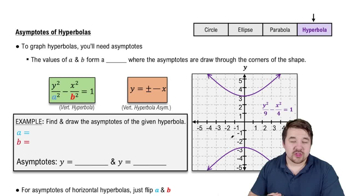
Asymptotes of a Hyperbola

Asymptotes are straight lines that the hyperbola approaches but never touches. For a hyperbola centered at (h, k), the asymptotes have equations y = k ± (b/a)(x - h) or y = k ± (a/b)(x - h), depending on the hyperbola's orientation. Finding asymptotes aids in sketching the hyperbola accurately.
Recommended video:
5:50
Asymptotes of Hyperbolas

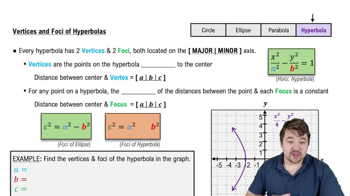
Foci of a Hyperbola

The foci are two fixed points located along the transverse axis, used to define the hyperbola. Their distance from the center is given by c, where c² = a² + b². Identifying the foci helps understand the hyperbola's shape and is essential for accurate graphing.
Recommended video:
5:22
Foci and Vertices of Hyperbolas