
Textbook Question
Intervals of Convergence
In Exercises 1–36, (a) find the series’ radius and interval of convergence. For what values of x does the series converge (b) absolutely, (c) conditionally?
∑ (from n = 0 to ∞) (2x)ⁿ

 Verified step by step guidance
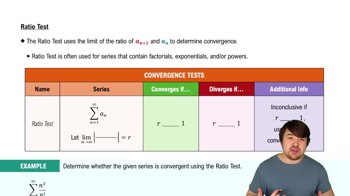
 05:35
05:35
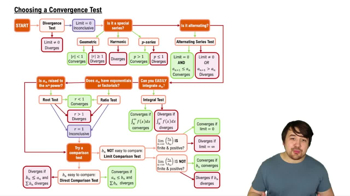 07:51
07:51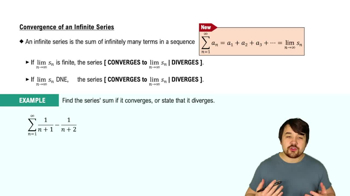 06:52
06:52Intervals of Convergence
In Exercises 1–36, (a) find the series’ radius and interval of convergence. For what values of x does the series converge (b) absolutely, (c) conditionally?
∑ (from n = 0 to ∞) (2x)ⁿ
Are there any values of x for which ∑ (from n=1 to ∞) (1 / nˣ) converges? Give reasons for your answer.
Determining Convergence or Divergence
In Exercises 1–14, determine whether the alternating series converges or diverges. Some of the series do not satisfy the conditions of the Alternating Series Test.
∑ (from n = 2 to ∞) [(-1)ⁿ⁺¹ (1 / ln n)]
Using the Root Test
In Exercises 9–16, use the Root Test to determine if each series converges absolutely or diverges.
∑(from n=1 to ∞) [(-1)ⁿ (1 − 1/n)ⁿ^²]
(Hint: lim (n→∞) (1 + x/n)ⁿ = eˣ)
Recursively Defined Sequences
In Exercises 101–108, assume that each sequence converges and find its limit.
a₁ = 2,aₙ₊₁ = 72 / (1 + aₙ)
Convergence and Divergence
Which of the sequences {aₙ} in Exercises 31–100 converge, and which diverge? Find the limit of each convergent sequence.
aₙ = nπ cos(nπ)