
Ch. 10 - Infinite Sequences and Series
Hass - Thomas' Calculus 15th Edition
Hass15th EditionThomas' CalculusISBN: 9780137616077Not the one you use?Change textbook
Chapter 10, Problem 10.6.10

Determining Convergence or Divergence
In Exercises 1–14, determine whether the alternating series converges or diverges. Some of the series do not satisfy the conditions of the Alternating Series Test.
∑ (from n = 2 to ∞) [(-1)ⁿ⁺¹ (1 / ln n)]

Verified step by step guidance
1
Identify the general term of the series: \(a_n = \frac{1}{\ln n}\) and the alternating factor is \((-1)^{n+1}\), so the series is \(\sum_{n=2}^\infty (-1)^{n+1} a_n\).
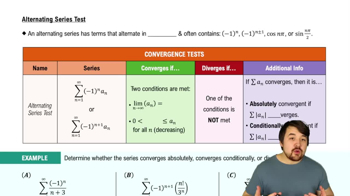
Recall the Alternating Series Test (Leibniz Test), which states that an alternating series \(\sum (-1)^n a_n\) converges if two conditions are met: (1) the sequence \(a_n\) is positive, decreasing, and (2) \(\lim_{n \to \infty} a_n = 0\).
Check if \(a_n = \frac{1}{\ln n}\) is positive and decreasing for \(n \geq 2\). Since \(\ln n\) is positive and increasing for \(n > 1\), \(a_n\) is positive and decreasing for \(n \geq 2\).
Evaluate the limit \(\lim_{n \to \infty} \frac{1}{\ln n}\). Since \(\ln n\) grows without bound as \(n\) approaches infinity, this limit is 0.
Since both conditions of the Alternating Series Test are satisfied, conclude that the series \(\sum_{n=2}^\infty (-1)^{n+1} \frac{1}{\ln n}\) converges.

Verified video answer for a similar problem:

This video solution was recommended by our tutors as helpful for the problem above.
Video duration:
3m
Was this helpful?

Key Concepts

Here are the essential concepts you must grasp in order to answer the question correctly.

Alternating Series Test

The Alternating Series Test determines convergence of series whose terms alternate in sign. It requires that the absolute value of terms decreases monotonically to zero. If these conditions hold, the series converges; otherwise, the test is inconclusive.
Recommended video:
10:54
Alternating Series Test

Behavior of the General Term

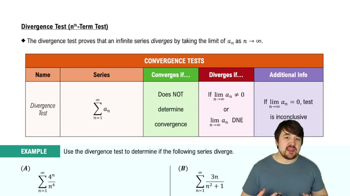
Analyzing the limit of the general term as n approaches infinity is crucial. For convergence, the terms must approach zero. In this series, the term 1/ln(n) decreases slowly, so checking its limit helps assess if the series can converge.
Recommended video:
05:44
Divergence Test (nth Term Test)

Logarithmic Functions and Their Growth

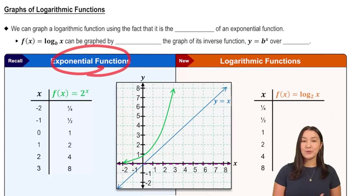
Understanding the growth rate of the natural logarithm function ln(n) is important. Since ln(n) grows without bound but very slowly, 1/ln(n) approaches zero but not rapidly. This slow decay affects the convergence behavior of the series.
Recommended video:
5:26
Graphs of Logarithmic Functions