Ch. 10 - Infinite Sequences and Series
Hass - Thomas' Calculus 15th Edition
Hass15th EditionThomas' CalculusISBN: 9780137616077Not the one you use?Change textbook
Chapter 10, Problem 10.1.48

Convergence and Divergence
Which of the sequences {aₙ} in Exercises 31–100 converge, and which diverge? Find the limit of each convergent sequence.
aₙ = nπ cos(nπ)

Verified step by step guidance
1
Start by analyzing the given sequence: \(a_n = n\pi \cos(n\pi)\). Notice that \(n\pi\) is a linear term in \(n\), and \(\cos(n\pi)\) is a trigonometric term that depends on \(n\).
Recall the behavior of \(\cos(n\pi)\). Since \(\cos(\theta)\) has period \(2\pi\), evaluate \(\cos(n\pi)\) for integer values of \(n\). Specifically, \(\cos(n\pi) = (-1)^n\) because \(\cos(n\pi)\) alternates between 1 and -1 depending on whether \(n\) is even or odd.
Rewrite the sequence using this identity: \(a_n = n\pi (-1)^n\). This means the sequence terms are \(n\pi\) multiplied by either 1 or -1, alternating sign as \(n\) increases.
Consider the limit of \(a_n\) as \(n\) approaches infinity. Since \(n\pi\) grows without bound and \((-1)^n\) only changes the sign, the terms oscillate between large positive and large negative values, so the sequence does not approach a finite limit.
Conclude that the sequence \(a_n\) diverges because it does not settle to a single finite value as \(n\) becomes very large.

Verified video answer for a similar problem:

This video solution was recommended by our tutors as helpful for the problem above.
Video duration:
2m
Was this helpful?

Key Concepts

Here are the essential concepts you must grasp in order to answer the question correctly.

Sequence Convergence and Divergence

A sequence converges if its terms approach a specific finite value as n approaches infinity; otherwise, it diverges. Understanding whether a sequence settles to a limit or oscillates without settling is fundamental to analyzing its behavior.
Recommended video:
Guided course
8:22
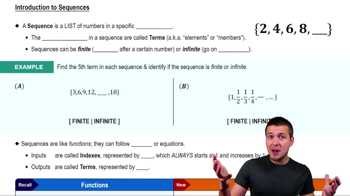
Introduction to Sequences

Behavior of the Cosine Function at Integer Multiples of π

The cosine of nπ alternates between 1 and -1 depending on whether n is even or odd, since cos(nπ) = (-1)^n. This alternating pattern affects the sign of the sequence terms and is crucial for determining convergence.
Recommended video:
5:53
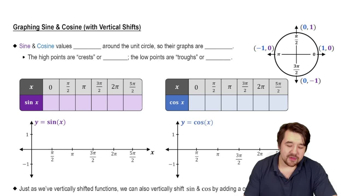
Graph of Sine and Cosine Function

Limits Involving Products of Sequences

When a sequence is defined as a product of two sequences, the limit depends on the behavior of each factor. If one factor grows without bound and the other oscillates, the overall sequence may diverge, highlighting the importance of analyzing each component.
Recommended video:
Guided course
8:22
Introduction to Sequences