Ch.12 - Parametric and Polar Curves
Briggs - Calculus: Early Transcendentals 3rd Edition
Briggs3rd EditionCalculus: Early TranscendentalsISBN: 9780136847243Not the one you use?Change textbook
Chapter 12, Problem 12.R.35

Polar conversion Write the equation r ² +r(2sinθ−6cosθ)=0 in Cartesian coordinates and identify the corresponding curve.

Verified step by step guidance
1
Start with the given polar equation: \(r^{2} + r(2\sin\theta - 6\cos\theta) = 0\).
Recall the relationships between polar and Cartesian coordinates: \(x = r\cos\theta\), \(y = r\sin\theta\), and \(r^{2} = x^{2} + y^{2}\).
Rewrite each term in the equation using these relationships: replace \(r^{2}\) with \(x^{2} + y^{2}\), replace \(r\sin\theta\) with \(y\), and replace \(r\cos\theta\) with \(x\).
Substitute these into the equation to get: \((x^{2} + y^{2}) + (2y - 6x) = 0\).
Simplify and rearrange the equation to standard Cartesian form, then analyze the resulting equation to identify the type of curve it represents (such as a circle, ellipse, parabola, or hyperbola).

Verified video answer for a similar problem:

This video solution was recommended by our tutors as helpful for the problem above.
Video duration:
3m
Was this helpful?

Key Concepts

Here are the essential concepts you must grasp in order to answer the question correctly.

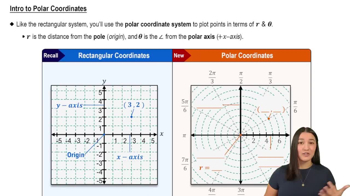
Polar to Cartesian Coordinate Conversion

This involves translating equations from polar form (r, θ) to Cartesian form (x, y) using the relationships x = r cos θ and y = r sin θ. Understanding these conversions allows one to rewrite polar equations in terms of x and y for easier analysis.
Recommended video:
05:32
Intro to Polar Coordinates

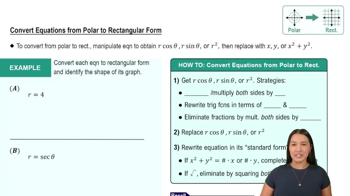
Algebraic Manipulation of Polar Equations

Rearranging and simplifying polar equations often requires substituting r and trigonometric terms with Cartesian equivalents and then algebraically manipulating the resulting expressions. This step is crucial to express the equation in a recognizable Cartesian form.
Recommended video:
6:50
Convert Equations from Polar to Rectangular

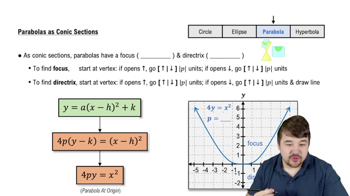
Identification of Conic Sections

Once the equation is in Cartesian form, recognizing the type of curve (circle, ellipse, parabola, or hyperbola) involves comparing it to standard conic section equations. This helps in understanding the geometric nature of the curve represented by the original polar equation.
Recommended video:
5:33
Parabolas as Conic Sections