Ch.12 - Parametric and Polar Curves
Briggs - Calculus: Early Transcendentals 3rd Edition
Briggs3rd EditionCalculus: Early TranscendentalsISBN: 9780136847243Not the one you use?Change textbook
Chapter 12, Problem 12.R.51

51–52. {Use of Tech} Arc length of polar curves Find the approximate length of the following curves.
The limaçon r=3−6cosθ

Verified step by step guidance
1
Recall the formula for the arc length \( L \) of a polar curve \( r = f(\theta) \) from \( \theta = a \) to \( \theta = b \): \[ L = \int_{a}^{b} \sqrt{r(\theta)^2 + \left(\frac{dr}{d\theta}\right)^2} \, d\theta \]
Identify the given polar function: \( r(\theta) = 3 - 6 \cos \theta \). Next, compute its derivative with respect to \( \theta \): \[ \frac{dr}{d\theta} = 6 \sin \theta \]
Determine the interval for \( \theta \) over which to find the arc length. Since the limaçon is typically traced once as \( \theta \) goes from \( 0 \) to \( 2\pi \), set the limits of integration as \( a = 0 \) and \( b = 2\pi \).
Substitute \( r(\theta) \) and \( \frac{dr}{d\theta} \) into the arc length formula: \[ L = \int_{0}^{2\pi} \sqrt{(3 - 6 \cos \theta)^2 + (6 \sin \theta)^2} \, d\theta \]
Simplify the expression inside the square root if possible, then use a suitable numerical method or technology (such as a graphing calculator or software) to approximate the value of the integral, which gives the length of the limaçon.

Verified video answer for a similar problem:

This video solution was recommended by our tutors as helpful for the problem above.
Video duration:
5m
Was this helpful?

Key Concepts

Here are the essential concepts you must grasp in order to answer the question correctly.

Polar Coordinates and Polar Curves

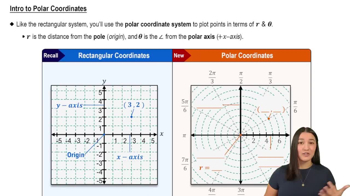
Polar coordinates represent points in the plane using a radius and an angle (r, θ). Polar curves are defined by equations relating r and θ, such as r = 3 - 6 cos θ. Understanding how to interpret and plot these curves is essential for analyzing their properties, including length.
Recommended video:
05:32
Intro to Polar Coordinates

Arc Length Formula for Polar Curves

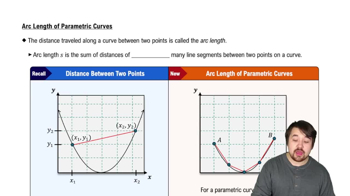
The arc length of a polar curve r(θ) from θ = a to θ = b is given by the integral ∫ from a to b of √[r(θ)² + (dr/dθ)²] dθ. This formula combines the radius and its rate of change to measure the curve's length accurately.
Recommended video:
06:29
Arc Length of Parametric Curves

Differentiation of Polar Functions

To apply the arc length formula, you must differentiate the polar function r(θ) with respect to θ. This involves using standard differentiation rules to find dr/dθ, which is crucial for evaluating the integral that gives the curve's length.
Recommended video:
05:32
Intro to Polar Coordinates