
Ch.12 - Parametric and Polar Curves
Briggs - Calculus: Early Transcendentals 3rd Edition
Briggs3rd EditionCalculus: Early TranscendentalsISBN: 9780136847243Not the one you use?Change textbook
Chapter 12, Problem 12.1.69a

67–72. Derivatives Consider the following parametric curves.
a. Determine dy/dx in terms of t and evaluate it at the given value of t.


x = cos t, y = 8 sin t; t = π/2

Verified step by step guidance
1
Recall that for parametric curves defined by \(x = x(t)\) and \(y = y(t)\), the derivative \(\frac{dy}{dx}\) can be found using the chain rule as \(\frac{dy}{dx} = \frac{\frac{dy}{dt}}{\frac{dx}{dt}}\).
Given the parametric equations \(x = \cos t\) and \(y = 8 \sin t\), compute the derivatives with respect to \(t\): \(\frac{dx}{dt} = -\sin t\) and \(\frac{dy}{dt} = 8 \cos t\).
Substitute these derivatives into the formula for \(\frac{dy}{dx}\) to get \(\frac{dy}{dx} = \frac{8 \cos t}{-\sin t} = -8 \frac{\cos t}{\sin t}\).
Evaluate \(\frac{dy}{dx}\) at the given value \(t = \frac{\pi}{2}\) by substituting \(t\) into the expression \(-8 \frac{\cos t}{\sin t}\).
Simplify the expression after substitution to find the slope of the curve at \(t = \frac{\pi}{2}\).

Verified video answer for a similar problem:

This video solution was recommended by our tutors as helpful for the problem above.
Video duration:
2m
Was this helpful?

Key Concepts

Here are the essential concepts you must grasp in order to answer the question correctly.

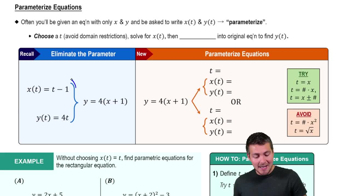
Parametric Equations

Parametric equations express the coordinates of points on a curve as functions of a parameter, often denoted as t. Instead of y as a function of x, both x and y depend on t, allowing the description of more complex curves. Understanding how to work with these equations is essential for analyzing motion and curves in calculus.
Recommended video:
Guided course
08:02
Parameterizing Equations

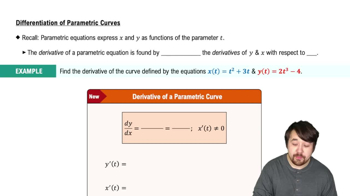
Derivative of Parametric Curves (dy/dx)

For parametric curves, the derivative dy/dx is found by dividing the derivative of y with respect to t by the derivative of x with respect to t, i.e., (dy/dt) / (dx/dt). This method allows us to find the slope of the tangent line to the curve at a specific parameter value, even when y is not explicitly given as a function of x.
Recommended video:
06:49
Differentiation of Parametric Curves

Evaluating Derivatives at Specific Parameter Values

After finding the general expression for dy/dx in terms of t, evaluating it at a specific value of t gives the slope of the tangent line at that point on the curve. This step involves substituting the given t-value into the derivative expressions and simplifying to find the numerical slope.
Recommended video:
5:10
Evaluate Composite Functions - Values on Unit Circle