
Ch.12 - Parametric and Polar Curves
Briggs - Calculus: Early Transcendentals 3rd Edition
Briggs3rd EditionCalculus: Early TranscendentalsISBN: 9780136847243Not the one you use?Change textbook
Chapter 12, Problem 12.2.106a

(Use of Tech) Finger curves: r = f(θ) = cos(aᶿ) - 1.5, where a = (1 + 12π)^(1/(2π)) ≈ 1.78933
a. Show that f(0) = f(2π) and find the point on the curve that corresponds to θ = 0 and θ = 2π.

Verified step by step guidance
1
First, write down the given function explicitly: \(r = f(\theta) = \cos(a\theta) - 1.5\), where \(a = (1 + 12\pi)^{\frac{1}{2\pi}}\).
To show that \(f(0) = f(2\pi)\), substitute \(\theta = 0\) into the function: \(f(0) = \cos(a \cdot 0) - 1.5 = \cos(0) - 1.5\).
Next, substitute \(\theta = 2\pi\) into the function: \(f(2\pi) = \cos(a \cdot 2\pi) - 1.5\).
Use the property of the cosine function that \(\cos(\alpha + 2\pi k) = \cos(\alpha)\) for any integer \(k\). Since \(a \cdot 2\pi\) can be expressed in terms of an integer plus a fractional part, analyze \(a \cdot 2\pi\) to see if it corresponds to an integer multiple of \(2\pi\) or how it affects the cosine value.
Finally, find the points on the curve for \(\theta = 0\) and \(\theta = 2\pi\) by converting from polar coordinates \((r, \theta)\) to Cartesian coordinates using \(x = r \cos(\theta)\) and \(y = r \sin(\theta)\) for each value of \(\theta\).

Verified video answer for a similar problem:

This video solution was recommended by our tutors as helpful for the problem above.
Video duration:
3m
Was this helpful?

Key Concepts

Here are the essential concepts you must grasp in order to answer the question correctly.

Polar Coordinates and Parametric Curves

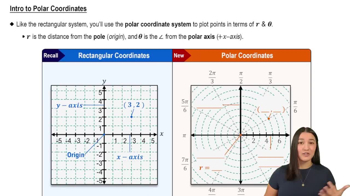
Polar coordinates represent points using a radius r and angle θ, where r = f(θ) defines a curve. Understanding how to interpret and plot points given by r and θ is essential, especially when θ varies over an interval like [0, 2π]. This helps in analyzing the shape and properties of curves defined in polar form.
Recommended video:
05:32
Intro to Polar Coordinates

Periodicity and Function Evaluation

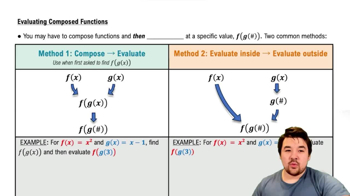
Periodicity refers to a function repeating its values at regular intervals. Showing that f(0) = f(2π) involves evaluating the function at these points and understanding the behavior of trigonometric functions like cosine, which are periodic with period 2π. This concept is key to proving equality and identifying points on the curve.
Recommended video:
4:26
Evaluating Composed Functions

Substitution and Simplification of Expressions

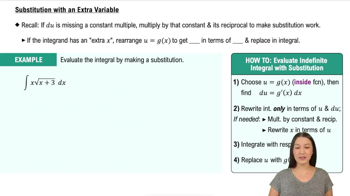
Substitution involves replacing variables with given values to evaluate functions. Simplifying expressions, especially those involving exponents and trigonometric functions, is necessary to find exact values of r at specific θ values. This skill is crucial for determining the coordinates of points on the curve.
Recommended video:
04:27
Substitution With an Extra Variable
Related Practice
Textbook Question

11–14. Working with parametric equations Consider the following parametric equations.

a. Make a brief table of values of t, x, and y.

b. Plot the (x, y) pairs in the table and the complete parametric curve, indicating the positive orientation (the direction of increasing t).


x=−t+6, y=3t−3; −5≤t≤5 

1
views
Textbook Question

11–14. Working with parametric equations Consider the following parametric equations.

a. Make a brief table of values of t, x, and y.

b. Plot the (x, y) pairs in the table and the complete parametric curve, indicating the positive orientation (the direction of increasing t).


x=2 t,y=3t−4;−10≤d≤10 

Textbook Question

Volume of a hyperbolic cap Consider the region R bounded by the right branch of the hyperbola x²/a² - y²/b² = 1 and the vertical line through the right focus.

a. What is the volume of the solid that is generated when R is revolved about the x-axis?

Textbook Question

Explain why or why not Determine whether the following statements are true and give an explanation or counterexample.  


a. The point with Cartesian coordinates (−2, 2) has polar coordinates (2√2, 3π/4), (2√2, 11π/4), (2√2, −5π/4), and (−2√2,−π/4).  

1
views
Textbook Question

67–72. Derivatives Consider the following parametric curves.

a. Determine dy/dx in terms of t and evaluate it at the given value of t.


x = cos t, y = 8 sin t; t = π/2

1
views
Textbook Question

67–72. Derivatives Consider the following parametric curves.

a. Determine dy/dx in terms of t and evaluate it at the given value of t.


x = t + 1/t, y = t − 1/t; t = 1

1
views