Ch.12 - Parametric and Polar Curves
Briggs - Calculus: Early Transcendentals 3rd Edition
Briggs3rd EditionCalculus: Early TranscendentalsISBN: 9780136847243Not the one you use?Change textbook
Chapter 12, Problem 12.R.60b

A polar conic section Consider the equation r² = sec2θ
b. Find the vertices, foci, directrices, and eccentricity of the curve."

Verified step by step guidance
1
Rewrite the given polar equation \(r^2 = \sec^2 \theta\) in a more standard form. Recall that \(\sec \theta = \frac{1}{\cos \theta}\), so express \(r\) in terms of \(\theta\) and simplify accordingly.
Identify the type of conic by comparing the equation to the general polar conic form \(r = \frac{ed}{1 \pm e \cos \theta}\) or \(r = \frac{ed}{1 \pm e \sin \theta}\). This will help determine the eccentricity \(e\) and the directrix distance \(d\).
Find the eccentricity \(e\) by analyzing the relationship between \(r\) and \(\theta\) in the equation. Recall that eccentricity measures how much the conic deviates from being a circle.
Determine the vertices by finding the values of \(r\) when \(\theta\) corresponds to the maximum and minimum distances from the pole (origin). This usually happens when the denominator in the standard form is minimized or maximized.
Locate the foci and directrices using the eccentricity and the directrix distance. The focus is at the pole for polar conics, and the directrix lines are located at distances related to \(d\) along the polar axis.

Verified video answer for a similar problem:

This video solution was recommended by our tutors as helpful for the problem above.
Video duration:
9m
Was this helpful?

Key Concepts

Here are the essential concepts you must grasp in order to answer the question correctly.

Polar Coordinates and Polar Equations

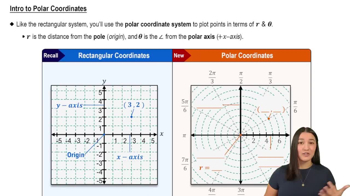
Polar coordinates represent points using a radius r and angle θ from the origin. Polar equations express curves in terms of r and θ, allowing the description of conic sections like circles, ellipses, parabolas, and hyperbolas in a coordinate system centered at the pole.
Recommended video:
05:32
Intro to Polar Coordinates

Conic Sections in Polar Form

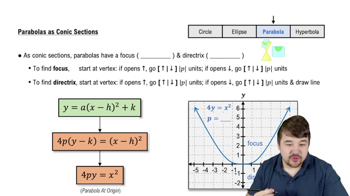
Conic sections can be represented in polar form using equations involving r, θ, eccentricity e, and directrix. The general form r = ed / (1 ± e cos θ) or r = ed / (1 ± e sin θ) relates the radius to the angle, eccentricity, and directrix, helping identify vertices, foci, and directrices.
Recommended video:
5:33
Parabolas as Conic Sections

Eccentricity, Vertices, Foci, and Directrices

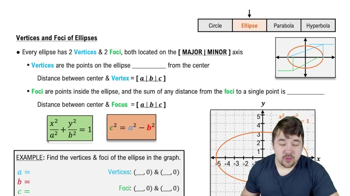
Eccentricity (e) measures how much a conic deviates from a circle; e=0 is a circle, 0<e<1 an ellipse, e=1 a parabola, and e>1 a hyperbola. Vertices are points closest or farthest from the pole, foci are fixed points defining the conic, and directrices are lines used to define the conic via the eccentricity.
Recommended video:
5:30
Foci and Vertices of an Ellipse