Ch.12 - Parametric and Polar Curves
Briggs - Calculus: Early Transcendentals 3rd Edition
Briggs3rd EditionCalculus: Early TranscendentalsISBN: 9780136847243Not the one you use?Change textbook
Chapter 12, Problem 12.R.72b

Parabola-hyperbola tangency: Let P be the parabola y = px² and H be the right half of the hyperbola x² - y² = 1.
b. At what point does the tangency occur?

Verified step by step guidance
1
Write down the equations of the two curves: the parabola \(y = p x^{2}\) and the hyperbola \(x^{2} - y^{2} = 1\) (considering only the right half, so \(x \geq 0\)).
Express the hyperbola in terms of \(y\) to find \(y\) as a function of \(x\): \(y = \pm \sqrt{x^{2} - 1}\). Since we consider the right half, \(x \geq 1\) and \(y\) can be either positive or negative depending on the branch.
To find the point of tangency, set the \(y\) values equal: \(p x^{2} = \sqrt{x^{2} - 1}\) (considering the positive branch for \(y\)). This gives a relation between \(x\) and \(p\) at the tangency point.
Find the derivatives (slopes) of both curves at the point of tangency. For the parabola, \(\frac{dy}{dx} = 2 p x\). For the hyperbola, implicitly differentiate \(x^{2} - y^{2} = 1\) to get \(2x - 2y \frac{dy}{dx} = 0\), so \(\frac{dy}{dx} = \frac{x}{y}\).
Set the slopes equal at the tangency point: \(2 p x = \frac{x}{y}\). Use the relation \(y = p x^{2}\) to substitute for \(y\) and solve for \(x\). Then use this \(x\) to find the corresponding \(y\) coordinate, which gives the point of tangency.

Verified video answer for a similar problem:

This video solution was recommended by our tutors as helpful for the problem above.
Video duration:
5m
Was this helpful?

Key Concepts

Here are the essential concepts you must grasp in order to answer the question correctly.

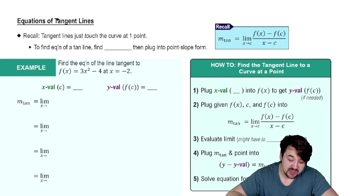
Equation of Tangent Lines to Curves

The tangent line to a curve at a point is the line that just touches the curve without crossing it locally. For a given curve, the slope of the tangent line is found by differentiating the curve's equation. Understanding how to find and express tangent lines is essential to determine where two curves share a common tangent.
Recommended video:
05:14
Equations of Tangent Lines

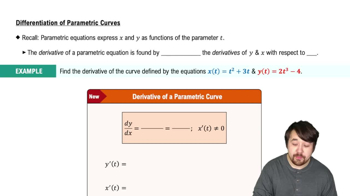
Parametric and Implicit Differentiation

When dealing with curves defined implicitly or parametrically, implicit differentiation allows us to find the derivative dy/dx without explicitly solving for y. This technique is crucial for curves like hyperbolas, where y is not isolated, enabling the calculation of slopes needed for tangency conditions.
Recommended video:
06:49
Differentiation of Parametric Curves

Conditions for Tangency Between Two Curves

Two curves are tangent at a point if they intersect there and their tangent lines have the same slope. This requires solving the system of equations given by the curves and equating their derivatives at the point of contact, ensuring both position and slope match.
Recommended video:
05:23
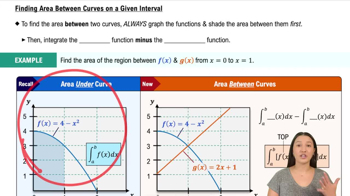
Finding Area Between Curves on a Given Interval