
Textbook Question
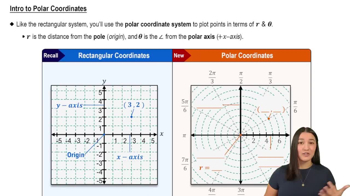
40–41. {Use of Tech} Slopes of tangent lines
b. Find the slope of the lines tangent to the curve at the origin (when relevant).
r =3 − 6 cos θ

 Verified step by step guidance
 05:32
05:32
 7:17
7:17 5:33
5:3340–41. {Use of Tech} Slopes of tangent lines
b. Find the slope of the lines tangent to the curve at the origin (when relevant).
r =3 − 6 cos θ
65–68. Eccentricity-directrix approach Find an equation of the following curves, assuming the center is at the origin. Graph the curve, labeling vertices, foci, asymptotes (if they exist), and directrices.
A hyperbola with vertices (±4, 0) and directrices x = ±2
19–20. Area bounded by parametric curves Find the area of the following regions. (Hint: See Exercises 103–105 in Section 12.1.) The region bounded by the y-axis and the parametric curve
The region bounded by the x-axis and the parametric curve x=cost, y=sin2t, for 0≤t≤π/2
14–18. Parametric descriptions Write parametric equations for the following curves. Solutions are not unique.
The circle x ² + y ² =9, generated clockwise
58–59. Tangent lines Find an equation of the line tangent to the following curves at the given point. Check your work with a graphing utility.
x²/16 - y²/9 = 1; (20/3, -4)
Explain why or why not Determine whether the following statements are true and give an explanation or counterexample.
e. The hyperbola y²/2 - x²/4 = 1 has no x-intercept.