Ch.12 - Parametric and Polar Curves
Briggs - Calculus: Early Transcendentals 3rd Edition
Briggs3rd EditionCalculus: Early TranscendentalsISBN: 9780136847243Not the one you use?Change textbook
Chapter 12, Problem 12.R.20

19–20. Area bounded by parametric curves Find the area of the following regions. (Hint: See Exercises 103–105 in Section 12.1.) The region bounded by the y-axis and the parametric curve
The region bounded by the x-axis and the parametric curve x=cost, y=sin2t, for 0≤t≤π/2

Verified step by step guidance
1
Identify the parametric equations given: \(x = \cos t\) and \(y = \sin 2t\), with the parameter \(t\) ranging from \(0\) to \(\frac{\pi}{2}\).
Recall that the area under a parametric curve between \(t = a\) and \(t = b\) can be found using the integral formula: \(A = \int_a^b y(t) \frac{dx}{dt} \, dt\).
Compute the derivative of \(x\) with respect to \(t\): \(\frac{dx}{dt} = -\sin t\).
Set up the integral for the area bounded by the x-axis and the parametric curve: \(A = \int_0^{\frac{\pi}{2}} \sin 2t \cdot (-\sin t) \, dt\).
Simplify the integrand if possible, then evaluate the integral to find the area. Remember to consider the sign of the integrand to ensure the area is positive.

Verified video answer for a similar problem:

This video solution was recommended by our tutors as helpful for the problem above.
Video duration:
5m
Was this helpful?

Key Concepts

Here are the essential concepts you must grasp in order to answer the question correctly.

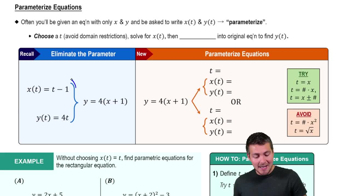
Parametric Equations and Curves

Parametric equations express the coordinates of points on a curve as functions of a parameter, often denoted t. Understanding how x and y vary with t allows us to describe complex curves that are not functions in the traditional y = f(x) sense. This is essential for analyzing areas bounded by such curves.
Recommended video:
Guided course
08:02
Parameterizing Equations

Area Under Parametric Curves

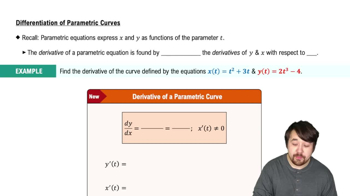
The area bounded by a parametric curve and an axis can be found using the integral of y(t) times the derivative of x(t) with respect to t, i.e., ∫ y(t) x'(t) dt. This formula accounts for the orientation and shape of the curve, enabling calculation of areas even when the curve loops or is not a function.
Recommended video:
06:49
Differentiation of Parametric Curves

Limits of Integration for Parametric Curves

Choosing the correct parameter interval [a, b] is crucial when computing areas with parametric curves. The limits correspond to the portion of the curve enclosing the region of interest. In this problem, t ranges from 0 to π/2, defining the segment of the curve relevant for the bounded area.
Recommended video:
06:49
Differentiation of Parametric Curves