
Ch.12 - Parametric and Polar Curves
Briggs - Calculus: Early Transcendentals 3rd Edition
Briggs3rd EditionCalculus: Early TranscendentalsISBN: 9780136847243Not the one you use?Change textbook
Chapter 12, Problem 12.R.17

14–18. Parametric descriptions Write parametric equations for the following curves. Solutions are not unique.
The circle x ² + y ² =9, generated clockwise

Verified step by step guidance
1
Recall that the standard parametric equations for a circle centered at the origin with radius \(r\) are \(x = r \cos(t)\) and \(y = r \sin(t)\), where \(t\) is the parameter representing the angle in radians.
Since the given circle is \(x^2 + y^2 = 9\), the radius \(r\) is \(3\). So the standard parametric form is \(x = 3 \cos(t)\) and \(y = 3 \sin(t)\).
Note that the standard parametric form traces the circle counterclockwise as \(t\) increases. To generate the circle clockwise, we need to reverse the direction of traversal.
To reverse the direction, replace \(t\) by \(-t\) in the parametric equations. This gives \(x = 3 \cos(-t)\) and \(y = 3 \sin(-t)\).
Use the even and odd properties of cosine and sine: \(\cos(-t) = \cos(t)\) and \(\sin(-t) = -\sin(t)\). So the parametric equations for the circle traced clockwise are \(x = 3 \cos(t)\) and \(y = -3 \sin(t)\).

Verified video answer for a similar problem:

This video solution was recommended by our tutors as helpful for the problem above.
Video duration:
3m
Was this helpful?

Key Concepts

Here are the essential concepts you must grasp in order to answer the question correctly.

Parametric Equations

Parametric equations express the coordinates of points on a curve as functions of a parameter, usually denoted t. Instead of y as a function of x, both x and y depend on t, allowing more flexible descriptions of curves, including direction and speed.
Recommended video:
Guided course
08:02
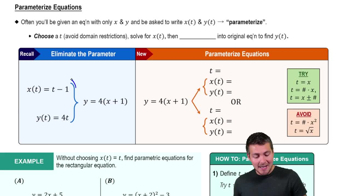
Parameterizing Equations

Equation of a Circle

The standard equation x² + y² = r² represents a circle centered at the origin with radius r. For r = 3, the circle includes all points (x, y) satisfying x² + y² = 9, forming a closed curve equidistant from the center.
Recommended video:
Guided course
06:03
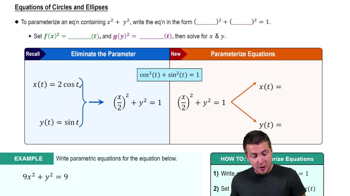
Parameterizing Equations of Circles & Ellipses

Orientation and Direction in Parametric Curves

Parametric curves have an orientation determined by how the parameter t increases. For a circle, the direction can be counterclockwise or clockwise, which affects the sign and order of the parametric functions, such as using sine and cosine with positive or negative signs.
Recommended video:
06:49
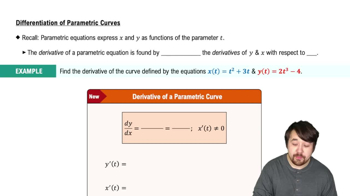
Differentiation of Parametric Curves